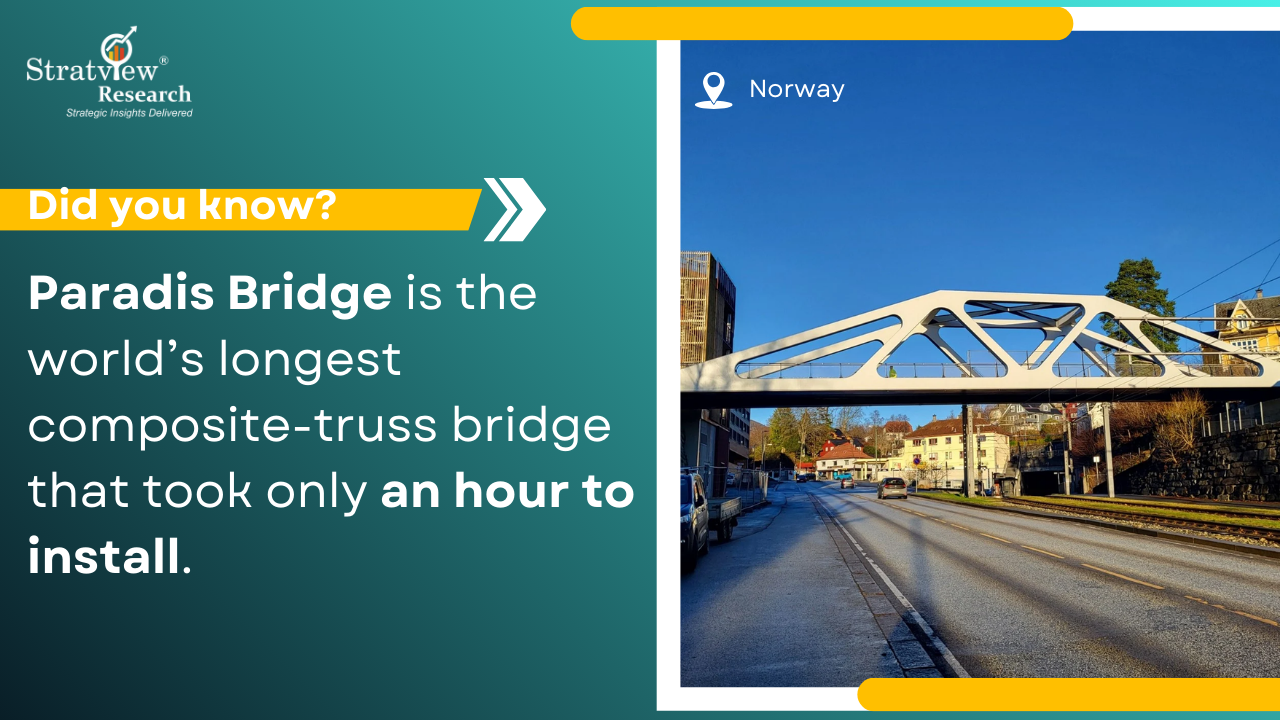
In a suburban neighbourhood of Bergen, Norway, engineers have quietly transformed what modern bridge construction looks like. The Paradis Bridge, a 42.5-metres long and 7.1 meters wide pedestrian and bicycle truss bridge, is fully composite, built entirely from fibreglass and carbon fibre and prefabricated as a single structure.
Now recognized as the world’s longest composite truss bridge, it connects the Paradis city train station across a busy road and light rail line, significantly improving safety for cyclists and pedestrians.
And while the bridge looks sleek and effortless today, what it represents is far more powerful, a major leap forward in how advanced composite materials are reshaping civil infrastructure.
From High-Performance Materials to Modern Bridges
Delivered by CSUB, a Norwegian engineering, procurement, and construction (EPC) specialist in composite solutions, the Paradis Bridge represents a new generation of lightweight infrastructure. Instead of relying on traditional steel and concrete, engineers adopted a hybrid composite architecture using carbon and glass fibre, similar to materials found in aerospace and high-performance vehicles. The goal was clear: create a bridge that could withstand harsh weather, resist corrosive road salt, and drastically reduce long-term maintenance. The result is a structure designed for extreme durability with an expected service life exceeding 100 years, while offering far greater design flexibility and architectural appeal.
Advanced Composite Engineering - Built at Record Speed
Here’s where it gets truly impressive.
Weighing only ~45 tonnes, the bridge is dramatically lighter than comparable steel structures, making full offsite prefabrication possible using advanced vacuum infusion technology. This approach ensured exceptional quality control, structural precision, and long-term performance.
Once complete, the entire superstructure was transported as a single unit and lifted directly into place, achieving full installation in just one hour. This high level of prefabrication significantly minimized disruption to traffic and rail operations while reducing overall installation time and project costs.
A Blueprint for the Future of Infrastructure
With its striking architectural design, inspired by Bergen’s local colors and identity, the Paradis Bridge is more than just a crossing. It’s a symbol of a future where infrastructure is sustainable, smart, and resilient.
From rapid installation to extreme durability and low maintenance, FRP bridges like this one are redefining what’s possible in urban development. They’re proof that with advanced composite materials, our cities can become safer, more sustainable, and ready for the challenges of tomorrow.
TAGS: Composite Materials CFRP GFRP