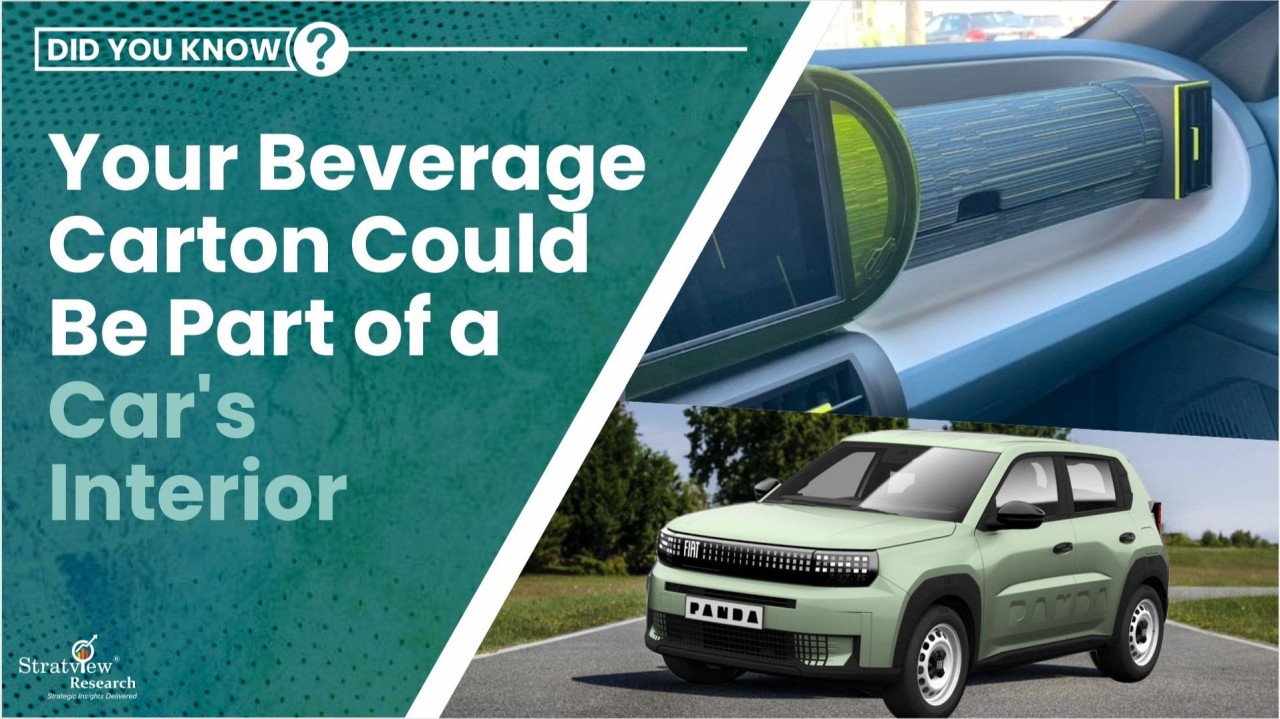
Fiat has launched an industry-first car using recycled PolyAl from used beverage cartons.
At first glance, the connection may seem unlikely, but materials recovered from beverage cartons are now entering automotive interior applications. As sustainability priorities expand across the automotive industry, innovation is no longer confined to electrification or powertrains. Increasingly, attention is shifting toward interior materials.
Beverage cartons are composed of paperboard layered with thin films of plastic and aluminium to protect liquids and extend shelf life. While the paperboard fraction has long been recycled into paper-based products, the remaining polymer–aluminium composite, known as PolyAl, has historically been difficult to reuse at scale. Recent advancements in recycling technologies and material compounding are now changing that scenario.
Today, recycled PolyAl is processed into high-quality compounds suitable for visible automotive interior components, including dashboards, centre consoles, and door panels. This approach is already being demonstrated in production vehicles like the Fiat Grande Panda, which incorporates recycled PolyAl into its interior design. Notably, each vehicle incorporates material equivalent to approximately 140 used beverage cartons, demonstrating how post-consumer packaging waste is being reintegrated into automotive manufacturing.
What makes this development particularly significant is its use in aesthetically demanding and performance-critical interior applications. The aluminium content within PolyAl creates a subtle visual texture, reinforcing that recycled materials can meet automotive durability, quality, and design expectations without compromise.
Beyond a single model, this innovation reflects a broader shift within the automotive interior materials market, where OEMs are increasingly adopting recycled polymers and composites to meet sustainability targets. As regulatory pressure and circular economy mandates intensify, interior materials are emerging as a key lever for responsible, future-ready automotive manufacturing.
TAGS: Automotive
Subscribe to our newsletter
Related Blogs:
Automotive Nonwoven – 101 – How They’re Made, Used, and Why They Matter
.jfif)
Automotive Carbon Ceramic Brakes Market - Explained in a Minute
Didn’t find what you were looking for?
Tell us about your requirements
(Our team usually responds within a few hours)