Global automotive manufacturers are navigating a convergence of structural challenges, including tightening emissions regulations, accelerating electrification, and rising material and manufacturing costs. While electrification improves drivetrain efficiency, it also introduces substantial mass through battery systems, often adding 300–600 kilograms to vehicle weight. This structural shift has elevated lightweighting from a secondary engineering objective to a central design and cost-management priority.
As a result, exterior and structural material systems are increasingly viewed as strategic levers for improving vehicle efficiency, range, and lifecycle performance. Within this context, advanced composite materials are gaining renewed attention for their ability to deliver weight reduction without compromising functional or aesthetic requirements.
The Benchmarking Landscape for Automotive Composites
Conventional automotive exterior panels are predominantly manufactured using steel, aluminum, or standard sheet molding compound (SMC) grades, typically characterized by densities in the range of 1.6-1.9 specific gravity (SpG). While aluminum has enabled meaningful weight savings compared with steel, further reductions have proven difficult without compromising cost or surface quality.
Traditional lightweight composites have addressed part of this gap but have often required trade-offs in surface finish, paintability, or manufacturing compatibility. As a result, widespread adoption has remained concentrated in premium and performance segments, where cost constraints are less restrictive.
The emergence of sub-1.0 SpG composite systems represents a structural shift in material efficiency, enabling weight reduction at a scale previously unattainable for high-volume exterior applications.
Positioning TCA Float Within the Material Ecosystem
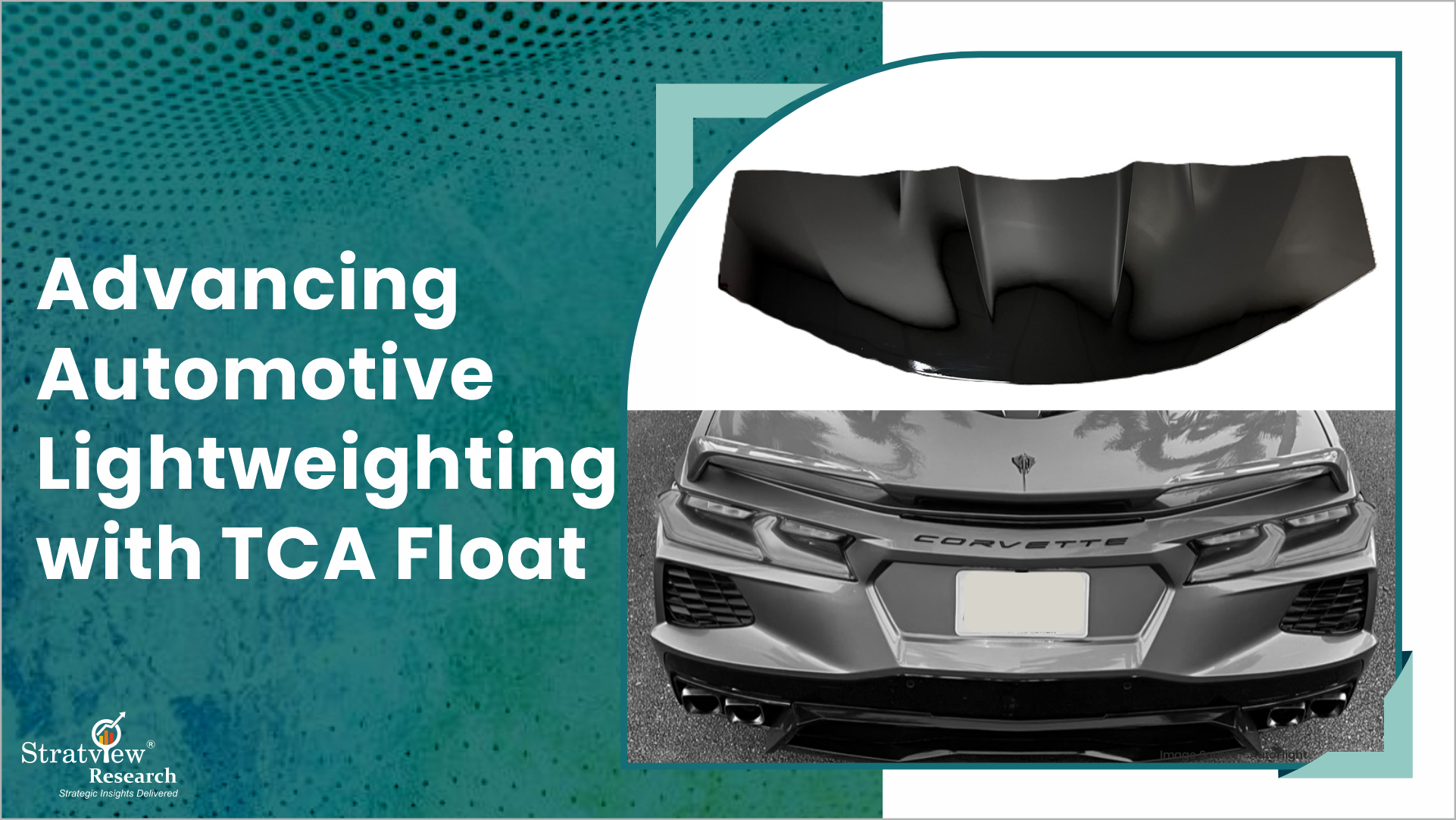
CSP’s TCA Float represents a next-generation advancement in sheet molding compound technology, engineered specifically for automotive body panels and exterior components. With a specific gravity below 1.0, TCA Float is approximately 23% lighter than CSP’s previous TCA Ultra Lite formulation, while maintaining comparable mechanical strength and surface characteristics.
A key differentiator is its ability to deliver a true Class A, paint-ready surface finish at ultra-low density. This combination addresses a long-standing limitation in lightweight composites, where reductions in mass were frequently accompanied by compromises in aesthetic quality.
Importantly, TCA Float has been developed as a drop-in replacement, allowing OEMs to integrate the material into existing production environments without modifications to tooling or processing workflows. This compatibility lowers adoption barriers and improves scalability across vehicle platforms.
Performance Characteristics and Manufacturing Economics
Despite its reduced density, TCA Float meets essential OEM performance requirements, including robust bond strength, consistent paint adhesion, and uniform surface quality. These characteristics enable its use in high-visibility exterior components such as removable roof panels, body panels, and structural exterior modules.
From an economic perspective, weight reduction at the component level generates compounding benefits at scale. For a high-volume vehicle program utilizing approximately 24 composite body panels, replacing TCA Ultra Lite with TCA Float can reduce vehicle mass by more than 24 kgs. Across annual production volumes, this translates into several thousand tons of material savings, contributing to improved energy efficiency, lower logistics costs, and reduced lifecycle emissions.
By combining lightweighting with manufacturing compatibility, TCA Float aligns material performance with volume economics, a critical requirement for large-scale automotive adoption.
Implications for Electrified Vehicle Platforms
Electrification has intensified the strategic importance of lightweight exterior systems. Battery packs typically increase vehicle mass by 10–15%, exerting direct pressure on driving range, energy consumption, and thermal management systems.
National Library of Medicine’s data suggests that every 10% of weight reduction can improve electric vehicle range by approximately 13.7%, depending on platform architecture. Within this framework, a 20–25 kgs reduction achieved through exterior lightweighting can deliver measurable efficiency gains or enable cost-effective battery downsizing.
By contributing to structural mass optimization without affecting surface quality, materials such as TCA Float support OEM efforts to balance range, cost, and performance in next-generation electric platforms.
Regional and Platform-Level Adoption Dynamics
Adoption patterns for advanced exterior composites vary across regions and vehicle segments. North America’s preference for pickup trucks, SUVs, and removable roof configurations creates favorable conditions for composite-intensive exterior systems. Europe’s focus on premium and performance vehicles similarly supports higher penetration of advanced materials.
In Asia Pacific, where cost sensitivity remains high in mass-market segments, drop-in compatibility and manufacturing efficiency are essential for wider adoption. TCA Float’s process integration capabilities position it favorably for deployment across diverse regional production environments.
At the platform level, modular architectures and shared body systems further amplify the value of scalable lightweight materials, enabling OEMs to standardize performance gains across multiple vehicle variants.
Strategic Role in Future Vehicle Architectures
Over the next decade, exterior lightweighting is expected to become increasingly integrated with broader vehicle system optimization, including battery thermal management, crash structures, and modular body architectures. Composite materials are likely to evolve from component-level solutions into platform-level enablers of efficiency and design flexibility.
Within this transition, TCA Float illustrates how material systems can simultaneously address weight reduction, surface quality, and manufacturing scalability. Its development reflects a broader industry movement toward composite solutions that deliver measurable performance gains without imposing operational complexity.
Enabling Scalable Lightweighting Without Compromise
TCA Float represents a material-level advancement aligned with the automotive industry’s evolving structural and economic priorities. By combining sub-1.0 SpG density, Class A surface quality, and drop-in manufacturability, it addresses multiple constraints that have historically limited composite adoption in exterior applications.
For OEMs navigating the intersecting pressures of electrification, regulation, and cost optimization, such materials provide a practical pathway to achieving meaningful weight reduction at scale. As vehicle architectures continue to evolve, solutions like TCA Float are likely to play an increasingly important role in shaping efficient, competitive, and sustainable mobility platforms.
TAGS: Composites Automotive
.jfif)