


404
+1-313-307-4176

Digital Radio Frequency Memory Market Analysis | 2025-2030

Digital Radio Frequency Memory Market Size, Share, Trends, Dynamics, Forecast, & Growth Analysis: 2025-2030
The digital radio frequency memory market was estimated at USD 1.2 billion in 2024 and is likely to grow at a CAGR of 11.7% during 2025-2030 to reach USD 2.3 billion in 2030.

Want to know more about the market scope? Register Here
Digital radio frequency memory is a process that digitally captures and then retransmits an RF signal. The process is available in defense, commercial, and civil platforms. Digital radio frequency memory has its application in different areas such as electronic warfare, radar test and evaluation, electronic warfare training, and radio and cellular network jamming.
Progressions in military technology have surged the development of unsurpassed air defense systems, which have posed a grave challenge for airborne units operating in enemy airspace, causing severe damage, attrition of units, and loss of personnel. Electronic warfare technologies are accentuated on mitigating the instances of detection by enemy radars and providing the necessary time to evade them. All these factors are significantly contributing to the growth of the global digital radio frequency memory market.
|
Segmentations |
List of Sub-Segments |
Segments with High Growth Opportunity |
|
Application Type Analysis |
Electronic Warfare, Radar Test and Evaluation, Electronic Warfare Training, and Radio and Cellular Network Jamming |
The electronic warfare segment is estimated to be the largest application segment of the market. |
|
Architecture Type Analysis |
Processors, Modulators, Converters, Memory, and Others |
The processors segment registered the largest share of the market in 2024. |
|
Regional Analysis |
North America, Europe, Asia-Pacific, and Rest of the World |
North America accounted for the largest share of the global DRFM market in 2024. |
Based on the platform type, the market is segmented as defense and commercial & civil. The defense segment comprises air, naval, land, and unmanned platforms. Naval DRFM systems are mostly employed for Electronic Support Measures (ESM). Giant players engaged in the manufacturing of naval DRFM systems deliver a wide range of Naval Laser Warning (NLW) systems, and ESM and ELINT systems for submarine and surface vessels. These naval DRFM systems render capabilities for early detection, analysis, threat warning, and protection from Anti-Ship Cruise Missiles (ASCMs).
Based on the application type, the market is segmented as electronic warfare, radar test and evaluation, electronic warfare training, and radio and cellular network jamming. The electronic warfare segment is estimated to be the largest application segment of the market. The electronic warfare systems are mounted on both air and naval platforms. Electronic warfare commands the electromagnetic spectrum to disrupt enemy electronic systems. The employment of DRFM systems in jammers has enhanced the capability of electronic warfare technologies. The DRFM systems incorporate the ability to store and modify signals before transmitting them to the enemy radar. These systems employ various deception techniques, such as multiple false target generation, range gate pull-off, and velocity gate pull-off, among others, to deceive the enemy radar. DRFM-based systems are further used for Communications Intelligence (COMINT) and Signals Intelligence (SIGINT) missions to arrest the electromagnetic signatures of enemy aircraft, ships, and other units. These electromagnetic signatures deliver intelligence about the capabilities of enemy ships and types of electronic systems in operation.
Based on the architecture type, the market is segmented as processors, modulators, converters, memory, and others. The memory stores the digital waveform of the inbound radar signal. DRFM processes this signal to be transmitted back to the target radar for deception jamming. Based on the architecture type, the processors segment registered the largest share of the market in 2024.
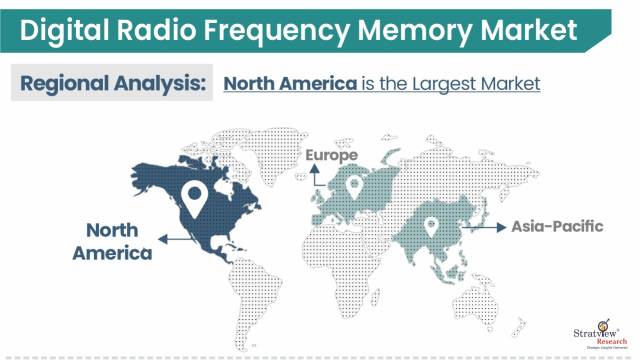
In terms of regions, North America accounted for the largest share of the global market in 2024. The market is driven by the increasing investments made by the defense forces in the region for the development of technologically-advanced DRFM systems. Giant manufacturers, such as Northrop Grumman Corporation (U.S.) and BAE Systems plc (U.K.), are among the well-renowned and prominent DRFM manufacturers in this region, who are estimated to drive the market during the forecast period. Europe and the Asia-Pacific are also expected to offer substantial growth opportunities in the coming five years.
Know the high-growth countries in this report. Register Here
Some of the major players in the digital radio frequency memory market are:
Note: The above list does not necessarily include all the top players in the market.
Are you the leading player in this market? We would love to include your name. Write to us at [email protected]
business value. It provides critical insights into market dynamics and will enable strategic decision-making for existing market players as well as those willing to enter the market. The following are the key features of the report:
This report studies the market, covering a period of 12 years of trends and forecasts. The report provides detailed insights into the market dynamics to enable informed business decision-making and growth strategy formulation based on the opportunities present in the market.
The digital radio frequency market is segmented into the following categories:
By Platform Type
By Architecture Type
By Application Type
By Region
This strategic assessment report, from Stratview Research, provides a comprehensive analysis that reflects today’s digital radio frequency memory market realities and future market possibilities for the forecast period of 2025 to 2030. After a continuous interest in our digital radio frequency market report from the industry stakeholders, we have tried to further accentuate our research scope to the digital radio frequency market to provide the most crystal-clear picture of the market. The report segments and analyses the market in the most detailed manner to provide a panoramic view of the market. The vital data/information provided in the report can play a crucial role for the market participants as well as investors in the identification of the low-hanging fruits available in the market as well as to formulate the growth strategies to expedite their growth process.
This report offers high-quality insights and is the outcome of a detailed research methodology comprising extensive secondary research, rigorous primary interviews with industry stakeholders, and validation and triangulation with Stratview Research’s internal database and statistical tools. More than 1000 authenticated secondary sources, such as company annual reports, fact books, press releases, journals, investor presentations, white papers, patents, and articles, have been leveraged to gather the data. We conducted more than 15 detailed primary interviews with the market players across the value chain in all four regions and industry experts to obtain both qualitative and quantitative insights.
With this detailed report, Stratview Research offers one of the following free customization options to our respectable clients:
Company Profiling
Competitive Benchmarking
Custom Research: Stratview Research offers custom research services across sectors. In case of any custom research requirement related to market assessment, competitive benchmarking, sourcing and procurement, target screening, and others, please send your inquiry to [email protected].
Digital radio frequency memory is a process that digitally captures and then retransmits RF signals. The process is available in defense, commercial, and civil platforms. Digital radio frequency memory has its application in different areas such as electronic warfare, radar test and evaluation, electronic warfare training, and radio and cellular network jamming.
The digital radio frequency memory market was estimated at USD 1.2 billion in 2024.
The forecasted value of the digital radio frequency memory market is expected to be USD 2.3 billion in 2030.
The digital radio frequency memory market is likely to grow at a CAGR of 11.7% during 2025-2030.
North America accounted for the largest share of the market in 2024.
Some of the major players in the market are Airbus Group, Bae Systems PLC, Curtiss-Wright Corporation, Elbit Systems Ltd., Thales Group, The Raytheon Company, Israel Aerospace Industries, Leonardo S.P.A., and Northrop Grumman Corporation.
The electronic warfare segment is expected to be the largest segment in the market in the coming years.
Progressions in military technology have surged the development of unsurpassed air defense systems, which have posed a grave challenge for airborne units operating in enemy airspace, causing severe damage, attrition of units, and loss of personnel. Electronic warfare technologies are accentuated on mitigating the instances of detection by enemy radars and providing the necessary time to evade them. All these factors are significantly contributing to the growth of the global market.


WE ACCEPT


