




404
+1-313-307-4176

Non-Municipal Trenchless Pipe Rehabilitation Market Analysis | 2026-2032

Non-Municipal Trenchless Pipe Rehabilitation Market Size, Share, Trend, Forecast, Competitive Analysis, and Growth Opportunity: 2026-2032
Non-Municipal Trenchless Pipe Rehabilitation Market is segmented by Method Type (CIPP, Pipe Bursting, Sliplining, SIPP, and Other Methods), by End-User Type (Airports, Military Bases, Universities, Manufacturing, Oil & Gas, and Other End-Users), by Pipe Diameter Type (18-inch pipes, 18–36-inch pipes, and >36-inch pipes), by Application Type (Water Main Pipes, Wastewater Pipes and Other Applications), and by Region (North America [The USA, Canada, and Mexico], Europe [Germany, France, The UK, Spain, and Rest of Europe], Asia-Pacific [China, Japan, Australia, Singapore, and Rest of Asia-Pacific], and Rest of the World [Latin America, The Middle East, and Others]).
The non-municipal trenchless pipe rehabilitation market value was USD 1.2 billion in 2025 and is likely to grow at a healthy CAGR of 5.1% during 2026-2032 to reach USD 1.8 billion in 2032.

Want to know more about the market scope? Register Here
Non-municipal trenchless pipe rehabilitation is a critical solution for extending the life of aging industrial, commercial, and utility pipelines without disruptive excavation. Globally, the market supports sectors, such as oil & gas, power, manufacturing, transportation, and private water networks by offering cost-effective, time-efficient, and asset-preserving rehabilitation methods. Key processes, including CIPP, pipe bursting, and sliplining, enable structural renewal while minimizing downtime and surface impact. Specialized contractors, innovative material suppliers, and specialized equipment providers drive technological advancement, positioning the non-municipal trenchless rehabilitation market as a strategic enabler for infrastructure reliability worldwide.
A considerable number of strategic alliances, including M&As, JVs, etc., have been performed over the past few years:
|
Method-Type Analysis |
CIPP, Pipe Bursting, Sliplining, SIPP, and Other Methods |
CIPP is expected to remain the dominant segment in the non-municipal trenchless pipe rehabilitation market, whereas Pipe Bursting is expected to exhibit the fastest growth during the forecast period. |
|
End-User- Type Analysis |
Airports, Military Bases, Universities, Manufacturing, Oil & Gas, and Other End-Users |
Oil & gas is expected to continue capturing the largest share of the non-municipal trenchless rehabilitation demand, whereas airport infrastructure is emerging as a high-growth segment. |
|
Pipe Diameter- Type Analysis |
18-inch pipes, 18–36-inch pipes, and >36-inch pipes |
Pipes measuring over 36 inches account for the largest share of demand and are also expected to register the fastest growth over the next six years. |
|
Application-Type Analysis |
Water Main Pipes, Wastewater Pipes, and Other Applications |
Water main pipes dominate application demand and are emerging as the primary growth driver, with wastewater and other non-municipal pipelines contributing steady value. |
|
Region Analysis |
North America, Europe, Asia-Pacific, and the Rest of the world |
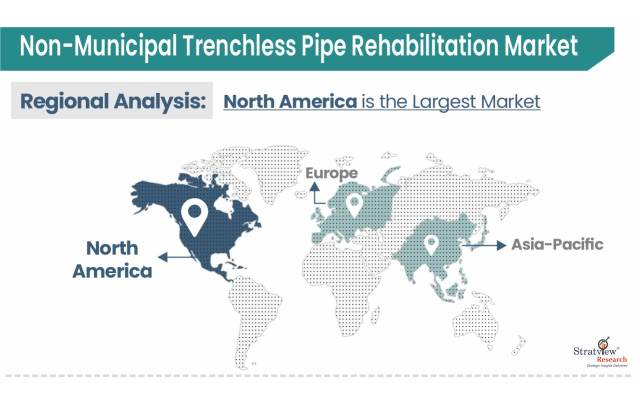
North America dominates the non-municipal trenchless pipe rehabilitation market, driven by extensive private and industrial pipeline networks, whereas the Asia-Pacific region is emerging as the fastest-growing region in the foreseeable future. |
“CIPP remains the dominant application segment in the non-municipal trenchless pipe rehabilitation market, whereas Pipe Bursting is expected to exhibit the highest growth rate till 2032.”
The non-municipal trenchless pipe rehabilitation market is segmented into CIPP, pipe bursting, sliplining, SIPP, and other methods. CIPP dominates the non-municipal trenchless pipe rehabilitation market, driven by its broad applicability across pipe diameters, ability to restore structural integrity, and minimal surface disruption in industrial and commercial assets. It remains the preferred method for complex networks and pressure pipelines requiring proven performance and reliability.
Pipe bursting represents the second-largest method segment and is gaining traction due to its suitability for full pipe replacement, capacity upsizing, and installation of HDPE and PVC pipes, particularly in severely deteriorated or undersized pipelines. Its adoption is increasing where long-term capacity enhancement and material upgrades are prioritized.
“Oil & gas continues to account for the largest share of non-municipal trenchless rehabilitation demand, whereas airport infrastructure is emerging as a high-growth segment over the next six years.”
The market is segmented into airports, military bases, universities, manufacturing, oil & gas, and other end-users. Oil & gas dominance is driven by extensive private pipeline networks, high integrity requirements, and the need for continuous rehabilitation to mitigate leakage, corrosion, and compliance risks without disrupting operations.
Airport infrastructure growth is being driven by large-scale airport modernization programs, particularly in the North American and Asia-Pacific regions, where rapid passenger traffic growth and capacity expansions are accelerating demand for rehabilitation of underground utilities.
“Pipes with >36-inch diameter account for the largest share of demand and are also expected to register the fastest growth during 2026-2032.”
The market is segmented into 18-inch pipes, 18–36-inch pipes, and >36-inch pipes. Large-diameter pipes with >36-inch diameter reflect their prevalence in critical non-municipal assets, such as oil & gas transmission lines, industrial process pipelines, and major utility crossings, where rehabilitation budgets and project values are significantly higher. And the increasing need to rehabilitate aging, high-capacity pipelines; greater adoption of trenchless methods; and higher capability to handle structural renewal and capacity upgrades in >36-inch pipe systems are likely to drive faster growth in the segment over the next six years.
“Water main pipes are likely to remain the dominant application with greater demand and are also emerging as the primary growth driver, with wastewater and other non-municipal pipelines contributing steady value to the market during the forecast period.”
The market is segmented into water main pipes, wastewater pipes, and other applications. Water mains are the leading application in the non-municipal trenchless market, holding the largest share in recent years.
Water main networks operate under significantly higher internal pressure and are subject to stringent service reliability and water quality standards, making failures both technically disruptive and publicly visible. As a result, asset owners adopt more proactive and structurally robust rehabilitation approaches to prevent leakage, pressure loss, and contamination risks.
Compared to wastewater and other non-municipal pipelines, which generally function under gravity flow and tolerate higher levels of degradation, water mains require more frequent intervention and advanced lining or replacement solutions, driving higher rehabilitation intensity and spending per kilometer. Wastewater and other non-municipal pipelines continue to generate steady demand, supported by regulatory maintenance and incremental capacity upgrades, but lack the urgency and scale of investment seen in potable water systems.
“North America dominates the non-municipal trenchless pipe rehabilitation market, driven by extensive private and industrial pipeline assets, whereas Asia-Pacific is emerging as the fastest-growing region during the forecast period.”
Among regions, North America’s dominance is underpinned by asset scale and privatization. The region hosts a large base of aging privately owned and industrial pipeline networks across energy, manufacturing, and commercial facilities, supported by higher capital availability and early adoption of trenchless rehabilitation technologies.
Asia-Pacific’s growth is driven by rapid industrialization and asset expansion; accelerating industrial activity, urban expansion, and increasing private participation in infrastructure are expanding the pipeline base, positioning Asia-Pacific as the fastest-growing region despite its smaller installed asset base today.
Know the high-growth countries in this report. Register Here
The market is moderately consolidated, with gradual market consolidation over the years. Most of the major players compete in some of the governing factors, including price, service offerings, regional presence, etc.
Here is the list of the Top Players (Based on Dominance)
Note: The above list does not necessarily include all the top players in the market.
Are you the leading player in this market? We would love to include your name. Please write to us at [email protected]
This report provides market intelligence most comprehensively. The report structure has been kept so that it offers maximum business value. It provides critical insights into market dynamics and will enable strategic decision-making for existing market players as well as those willing to enter the market. The following are the key features of the report:
The non-municipal trenchless pipe rehabilitation market is segmented into the following categories.
Non-Municipal Trenchless Pipe Rehabilitation Market, by Method Type
Non-Municipal Trenchless Pipe Rehabilitation Market, by End-User Type
Non-Municipal Trenchless Pipe Rehabilitation Market, by Pipe Diameter Type
Non-Municipal Trenchless Pipe Rehabilitation Market, by Application Type
Non-Municipal Trenchless Pipe Rehabilitation Market, by Region Type
With this detailed report, Stratview Research offers one of the following free customization options to our respected clients:
Company Profiling
Competitive Benchmarking
Custom Research: Stratview Research offers custom research services across industries. In case of any custom research requirement related to market assessment, competitive benchmarking, sourcing and procurement, target screening, and others, please send your inquiry to [email protected].
The non-municipal trenchless pipe rehabilitation market is projected to expand at a CAGR of 5.1% through 2032, supported by sustained investment in aging private and industrial pipeline assets.
The forecasted value of the non-municipal trenchless pipe rehabilitation market is expected to be USD 1.8 billion in 2032.
Azuria Water Solutions, Puris Corporation, SAK Construction, LLC, Per Aarsleff A/S (Aarsleff Pipe Technologies), Vortex Companies, LLC, Michels Corporation, Ashimori Industry Co., Ltd., RELINE UV Group, SAERTEX multiCom ® GmbH, and IMPREG Group are the key players in the market.
CIPP accounts for the largest share of the market, propelled by its key characteristics, such as a cost-effective, minimally disruptive solution with broad applicability across pipe diameters, materials, and operating conditions. Its ability to provide full structural renewal, faster installation, and longer service life boosts its preference over other methods for private and industrial asset owners, underpinning its majority share within the market.
Water main pipelines are expected to be the fastest-growing application segment in the market during the forecast period, driven by a larger installed base of water main pipelines coupled with the accelerating rehabilitation need for private water networks due to aging and rising investment needs to reduce leakage, improve pressure performance, and ensure service reliability.
North America remains the leading regional market for non-municipal trenchless pipe rehabilitation, reflecting its large installed base of privately owned and industrial pipelines, higher rehabilitation spending intensity, and well-established adoption of trenchless technologies across commercial and industrial end users.


WE ACCEPT