

Drone Detection Market | 2025-2032

Drone Detection Market | 2025-2032

Drone Detection Market | 2025-2032
Report code - SR3409
Analyst: Jagriti Lal Delivery - 2 Weeks
Drone Detection Market Size, Share, Trend, Forecast, Competitive Analysis, and Growth Opportunity: 2025-2032
See less...

Attractive Opportunities

Global Demand Analysis & Sales Opportunities in Drone Detection Market

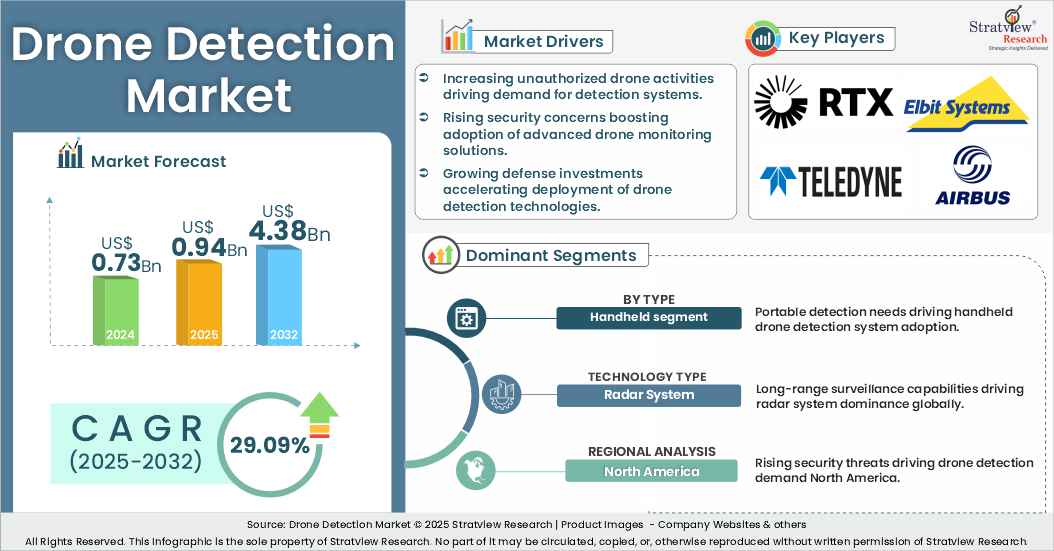
  • The annual demand for drone detection was USD 0.73 billion in 2024 and is expected to reach USD 0.94 billion in 2025, up 29.4% than the value in 2024.
  • During the next 8 years (forecast period of 2025-2032), the drone detection market is expected to grow at a CAGR of 29.09%. The annual demand will reach of USD 4.38 billion in 2032.
  • During 2025-2032, the drone detection industry is expected to generate a cumulative sales opportunity of USD 21.84 billion.

Drone Detection Market insights

Want to get a free sample? Register Here


High-Growth Market Segments:

  • North America is expected to be the dominant and fastest-growing region over the forecasted period.
  • By Type, Handheld segment is expected to be the fastest-growing segment during the forecast period.
  • By Range type, 5-10 Km segment is expected to be the fastest-growing segment during the forecast period.
  • By Technology type, Radar System segment is expected to dominate the market with the largest share during the forecast period.
  • By Application type, Critical Infrastructure segment is anticipated to have the highest CAGR during the forecast period.

Market Statistics

Have a look at the sales opportunities presented by the drone detection market in terms of growth and market forecast.

Drone Detection Market Data & Statistics


Market Statistics

Value (in USD Billion)

Market Growth (%)

Annual Market Size in 2023

USD 0.57 billion

-

Annual Market Size in 2024

USD 0.73 billion

YoY Growth in 2024: 29.2%

Annual Market Size in 2025

USD 0.94 billion

YoY Growth in 2025: 29.4%

Annual Market Size in 2032

USD 4.38 billion

CAGR 2025-2032: 29.09%

Cumulative Sales Opportunity during 2025-2032

USD 21.84 billion

  •  

Top 10 Countries’ Market Share in 2024

USD 0.75 billion +

> 80%

Top 10 Company’s Market Share in 2024

USD 0.46 billion to USD 0.65 billion

 50% - 70%

Market Dynamics

Introduction:

What is drone detection?

Drone detection refers to the use of autonomous and semi-autonomous robotic systems in military operations. These systems include unmanned aerial vehicles (UAVs), ground robots (UGVs), marine drones, weaponized turrets, and exoskeletons designed to enhance combat capabilities, reduce human risk, and improve mission efficiency. Drone detection technologies are widely used in intelligence, surveillance, and reconnaissance (ISR), combat operations, logistics and support, and search and rescue missions across land, air, and naval domains.

Market Drivers

Rising Unauthorized Drone Activities and Airspace Security Concerns

The rapid increase in unauthorized drone operations around airports, critical infrastructure, military facilities, and public events is driving drone detection market growth. Governments and infrastructure operators are strengthening surveillance capabilities using military radar, RF sensing, electro-optical sensors, and AI-enabled analytics to improve early threat detection and ensure safe airspace management.

  • According to the FAA, the agency receives more than 100 drone-sighting reports near airports every month. The growing frequency of unauthorized drone activity is increasing demand for advanced drone detection systems capable of identifying and tracking potential threats in real time.

  • The FAA has registered more than 1 million drones in the United States, including over 420,000 commercial drones, as of 2026. The expanding drone population is increasing the need for reliable airspace monitoring and counter-UAS detection technologies.

Growing Government Investments in Counter-UAS Capabilities

Increasing investments in homeland security and defense modernization are supporting drone detection market demand. Governments worldwide are deploying integrated counter-UAS solutions to protect airports, borders, military installations, energy infrastructure, and major public events from unauthorized drone activities.

  • During the 2026 FIFA World Cup, U.S. authorities intercepted more than 700 unauthorized drones while protecting nearly 250 Temporary Flight Restriction (TFR) zones. The large-scale security operation highlights the growing adoption of drone detection technologies for protecting high-profile events.

  • The U.S. Department of Defense continues expanding investments in counter-small unmanned aircraft systems (C-sUAS) under its Joint Counter-Small UAS Office (JCO). Increasing defense investments are accelerating deployment of multi-sensor drone detection platforms across military installations.

Market Challenges

Regulatory Restrictions on Counter-Drone Operations

Regulatory restrictions remain a major obstacle because many civilian operators are legally permitted to detect drones but cannot actively neutralize them. Differences in national regulations governing RF monitoring, electronic countermeasures, privacy, and spectrum usage continue to delay broader commercial deployment.

Detecting Small, Autonomous, and Swarm Drones

Detecting small, low-flying, autonomous, or swarm drones remains technically challenging because they generate weak radar signatures and often operate in cluttered urban environments. Vendors must continuously improve sensor fusion, AI algorithms, and detection accuracy while minimizing false alarms.

Market Opportunities

Growing Protection of Critical Infrastructure

Increasing investments in critical infrastructure protection are creating significant opportunities for the drone detection market forecast. Airports, power plants, oil & gas facilities, ports, data centers, and government facilities are increasingly deploying integrated drone detection platforms to strengthen physical security, improve situational awareness, and comply with evolving security regulations.

  • The U.S. Cybersecurity and Infrastructure Security Agency (CISA) continues expanding counter-UAS guidance and security programs for critical infrastructure operators across multiple sectors. Growing adoption of drone detection technologies is improving protection against unauthorized aerial threats.

Advancements in AI, Sensor Fusion, and Remote ID Technologies

Rapid advancements in artificial intelligence, machine learning, sensor fusion, and Remote ID are supporting drone detection market demand. These technologies improve drone identification accuracy, reduce false alarms, and enable scalable deployment across smart cities, transportation hubs, border security, and defense applications.

  • The FAA's Remote ID program became fully operational in 2025, requiring virtually all drones weighing more than 250 grams or operated under Part 107 to broadcast identification and location information during flight. The wider implementation of Remote ID is accelerating demand for drone detection platforms capable of integrating broadcast identification with radar, RF, and electro-optical sensors.

  • The European U-space program continued expanding in 2025, with the first certified U-space Service Provider (USSP) approved by EASA, supporting harmonized drone traffic management across the European Union. The rollout of digital airspace management is creating new opportunities for AI-enabled drone detection and integrated airspace surveillance systems. 

Segment Analysis

Segmentations

List of Sub-Segments

Segments with High-Growth Opportunity

Type Analysis

Ground-Based and Handheld

Handheld segment is expected to be the fastest-growing segment during the forecast period.

Range Analysis

<5 Km, 5-10 Km, and >10 Km

5-10 Km segment is expected to be the fastest-growing segment during the forecast period.

Technology Analysis

Radar System, RF Scanner, and Optical System

Radar System segment is expected to dominate the market with the largest share during the forecast period.

Application Analysis

Critical Infrastructure, Military & Defense, and Government & law Enforcement

Critical Infrastructure segment is anticipated to have the highest CAGR during the forecast period.

Regional Analysis

North America, Europe, Asia-Pacific, and The Rest of the World

North America is expected to be the dominant and fastest-growing region over the forecasted period.

By Type 

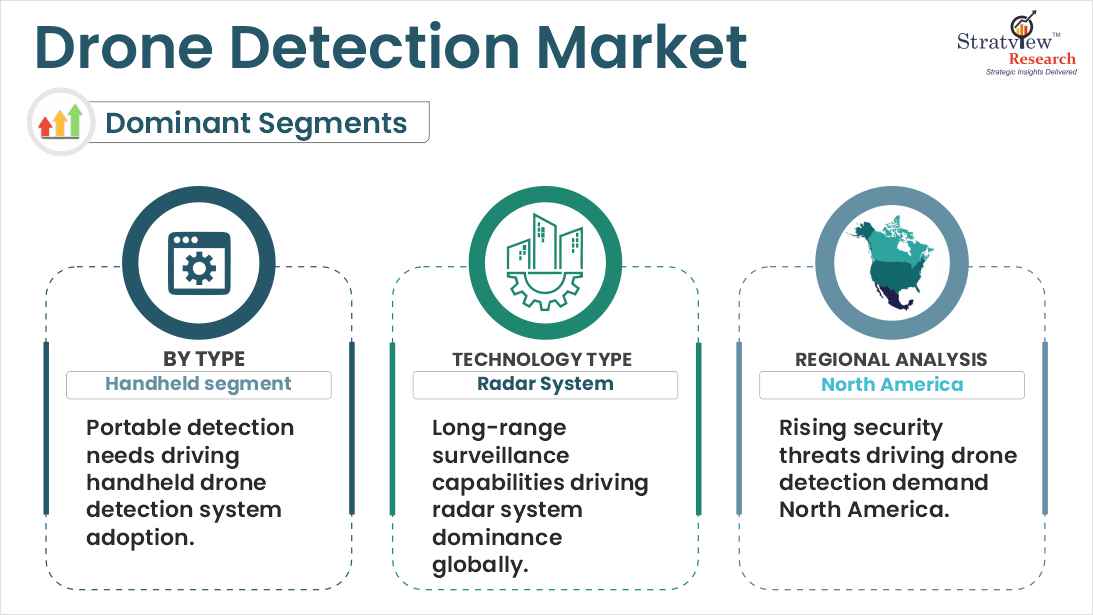
“Handheld segment is expected to be the fastest-growing segment during the forecast period.”

  • The drone detection market is segmented by type into ground-based and handheld.
  • Handheld segment is expected to be the fastest-growing segment during the forecast period, due to its portability, ease of deployment, and cost-effectiveness. These systems are ideal for field operations, event security, and mobile defense units, allowing quick response to drone threats.
  • Growing demand for flexible, on-the-go detection solutions across defense, law enforcement, and commercial sectors is accelerating this segment’s adoption.

By Technology Type 

“Radar System segment is expected to dominate the market with the largest share during the forecast period.”
  • The drone detection market is segmented by technology type into radar systems, RF scanners, and optical systems.
  • Radar System segment is expected to dominate the market with the largest share during the forecast period, due to its superior long-range surveillance, real-time tracking, and all-weather operational capabilities.
  • Integration of radar systems with AI-driven command and control systems further enhances threat detection and response, making it essential for defense, airport security, and critical infrastructure protection.

Drone Detection Market segments

Want to get more details about the segmentations? Register Here


Regional Analysis 

“North America is expected to be the dominant and fastest-growing region over the forecasted period.

  • In terms of region, the drone detection market is segmented into the North American region, the European region, the Asia-Pacific region, and the rest of the world.
  • North America is expected to be the dominant and fastest-growing region over the forecasted period, due to rising security threats from unauthorized drones near airports, military bases, and critical infrastructure.

  • Heavy investments in counter-drone technologies, supportive government regulations, and advancements in radar, RF, and EO/IR systems further drive regional growth. 

Competitive Landscape

Most of the major players compete in some of the factors, including price, service offerings, regional presence, etc. The following are the key players in the drone detection market -  

  • RTX
  • Teledyne
  • Elbit Systems Ltd.
  • Airbus SE
  • DroneShield Group  
  • Leonardo S.p.A.
  • Lockheed Martin Corporation
  • Raytheon Company
  • Saab AB
  • Thales Group
  • L3Harris Technologies Inc.

Note: The above list does not necessarily include all the top players in the market.

Are you a leading player in this market? We would love to include your name. Please write to us at [email protected]


Recent Developments/Mergers & Acquisitions: 

  • In December 2024, Saab AB (Sweden) secured a $48 million contract from BAE Systems (UK) to supply multiple Giraffe 4A radar systems. These advanced radars will be used by the US Air Forces in Europe to deliver long-range surveillance capabilities, specifically for enhancing airbase defense operations. 
  • In October 2024, L3Harris Technologies, Inc. (US) partnered with MatrixSpace (US) to showcase an advanced counter-UAS solution. The system combines UAS TRACER, Chimera software, WESCAM MX EO/IR sensors, and MatrixSpace Radar, offering enhanced drone detection and tracking capabilities along with rapid deployment features tailored for defense applications.

Report Features

This report provides market intelligence most comprehensively. The report structure has been kept so that it offers maximum business value. It provides critical insights into market dynamics and will enable strategic decision-making for existing market players as well as those willing to enter the market.

The following are the key features of the report:

  • Market structure: Overview, industry life cycle analysis, supply chain analysis.
  • Market environment analysis: Growth drivers and constraints, Porter’s five forces analysis, SWOT analysis.
  • Market trend and forecast analysis.
  • Market segment trend and forecast.
  • Competitive landscape and dynamics: Market share, Service portfolio, New Product Launches, etc.
  • COVID-19 impact and its recovery curve.
  • Attractive market segments and associated growth opportunities.
  • Emerging trends.
  • Strategic growth opportunities for the existing and new players.
  • Key success factors.

Market Study Period

2019-2032

Base Year

2024

Forecast Period

2025-2032

Trend Period

2019-2023

Number of Tables & Figures

>100

Number of Segments Analysed

5 (Type, Range Type, Technology Type, Application Type, and Region)

Number of Regions Analysed

4 (North America, Europe, Asia-Pacific, Rest of the World)

Countries Analysed

15 (The USA, Canada, Mexico, Germany, France, Italy, The UK, China, Japan, India, Brazil, Saudi Arabia, Rest of Europe, Rest of APAC, and Rest of the World)

Free Customization Offered

10%

After Sales Support

Unlimited

Report Presentation

Complimentary

Market Dataset

Complimentary

Further Deep Dive & Consulting Services

10% Discount


Market Segmentation

This report studies the market, covering a period of 15 years of trend and forecast. The report provides detailed insights into the market dynamics to enable informed business decision-making and growth strategy formulation based on the opportunities present in the market.


The drone detection market is segmented into the following categories. 

Drone Detection Market, by Type

  • Ground-Based
  • Handheld

Drone Detection Market, by Range Type

  • <5 Km
  • 5-10 Km
  • >10 Km

Drone Detection Market, by Technology Type

  • Radar System
  • RF Scanner
  • Optical System

Drone Detection Market, by Application Type

  • Critical Infrastructure
  • Military & Defense
  • Government & law Enforcement

Drone Detection Market, by Region

  • North America (Country Analysis: The USA, Canada, and Mexico)
  • Europe (Country Analysis: Germany, France, Italy, The UK, and Rest of Europe)
  • Asia-Pacific (Country Analysis: Japan, China, India, and Rest of Asia-Pacific)
  • Rest of the World (Country Analysis: Brazil, Saudi Arabia, and Others)

Research Methodology

  • This strategic assessment report from Stratview Research provides a comprehensive analysis that reflects today’s drone detection market realities and future market possibilities for the forecast period. 
  • The report segments and analyzes the market in the most detailed manner to provide a panoramic view of the market.
  • The vital data/information provided in the report can play a crucial role for market participants and investors in identifying the low-hanging fruits available in the market and formulating growth strategies to expedite their growth process.
  • This report offers high-quality insights and is the outcome of a detailed research methodology comprising extensive secondary research, rigorous primary interviews with industry stakeholders, and validation and triangulation with Stratview Research’s internal database and statistical tools.
  • More than 1,000 authenticated secondary sources, such as company annual reports, fact books, press releases, journals, investor presentations, white papers, patents, and articles, have been leveraged to gather the data.
  • We conducted more than 15 detailed primary interviews with market players across the value chain in all four regions and industry experts to obtain both qualitative and quantitative insights.

Customization Options

With this detailed report, Stratview Research offers one of the following free customization options to our respected clients:

Company Profiling

  • Detailed profiling of additional market players (up to three players)
  • SWOT analysis of key players (up to three players)

Competitive Benchmarking

  • Benchmarking of key players on the following parameters: Service portfolio, geographical reach, regional presence, and strategic alliances

Custom Research: Stratview Research offers custom research services across industries. In case of any custom research requirement related to market assessment, competitive benchmarking, sourcing and procurement, target screening, and others, please send your inquiry to [email protected]

Frequently Asked Questions (FAQs)

The report is delivered digitally through our online portal. Buyers receive login credentials from our team to access the report and may update their credentials at any time after the initial login.

Delivery timelines depend on the status of the report:

  • Published reports are typically delivered within 24 hours.
  • If the dataset is ready but the report is still being prepared, the dataset is usually delivered within 24 hours, while the completed report is delivered within 2 weeks.
  • For ongoing studies, both the dataset and the final report are generally delivered within 4–5 weeks .

For the most accurate delivery timeline, please contact us to confirm the current status of the report.

Yes. You may request a complimentary preview of the report through a video conference with our team.

Yes. The scope of the report can be fully customized to align with your specific research objectives and information requirements.
Please contact us at [email protected], and our team will be happy to discuss your requirements and propose a tailored solution.

Yes. Selected sections of the report can be purchased separately based on your requirements. Please contact us at [email protected] to discuss your needs.

Yes, AI can help gather publicly available information, but its outputs are only as reliable as the data it accesses. Stratview Research reports are built using validated data, extensive primary interviews with industry stakeholders, and the expertise of our experienced research team.

Additionally, many critical insights, including market dynamics, competitive intelligence, and industry-specific trends, are not publicly available and therefore cannot be captured through AI alone.

The drone detection market refers to the industry focused on developing and supplying technologies that identify, track, and monitor unauthorized or potentially harmful drones in controlled airspace. It includes radar systems, RF analyzers, optical sensors, and AI-powered software designed to enhance airspace security for military, government, commercial, and critical infrastructure applications.

The forecasted value for the market is US$4.38 billion in 2032.

The drone detection market size was USD 0.73 billion in 2024 and is expected to grow from USD 0.94 billion in 2025 to USD 4.38 billion in 2032, witnessing an impressive market growth (CAGR) of 29.09% during the forecast period (2025-2032).

The key drivers of the drone detection market include growing threats from unauthorized drone activities and adoption of drone detection systems in critical infrastructure.

The top players in the drone detection market include • RTX • Teledyne • Elbit Systems Ltd. • Airbus SE • DroneShield Group

North America is expected to be the dominant and fastest-growing region over the forecasted period, due to rising security threats from unauthorized drones near airports, military bases, and critical infrastructure.