




404
+1-313-307-4176

Satellite Solar Cell Materials Market Analysis | 2025-2032

Satellite Solar Cell Materials Market Size, Share, Trends, Dynamics, Forecast, & Growth Analysis: 2025-2032
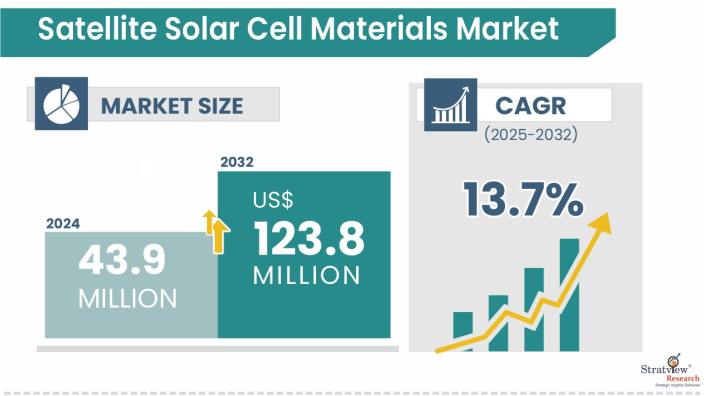
"satellite solar cell materials market size was USD 43.9 million in 2024.”
Want to know more about the market scope? Register Here
Have a look at the sales opportunities presented by the satellite solar cell materials market in terms of growth and market forecast.
Satellite Solar Cell Materials Market Data & Statistics
|
Market Statistics |
Value (in USD Million) |
Market Growth (%) |
|
Annual Market Size in 2023 |
USD 38.54 million |
|
|
Annual Market Size in 2024 |
USD 43.9 million |
YoY Growth in 2024: 13.9% |
|
Annual Market Size in 2025 |
USD 50.13 million |
YoY Growth in 2025: 14.20% |
|
Annual Market Size in 2032 |
USD 123.81 million |
CAGR 2025-2032: 13.79% |
|
Cumulative Sales Opportunity during 2025-2032 |
USD 660.01 million |
|
|
Top 10 Countries’ Market Share in 2024 |
USD 35.12 million + |
> 80% |
|
Top 10 Company’s Market Share in 2024 |
USD 21.95 million to USD 30.73 million |
50% - 70% |
Introduction
What is satellite solar cell materials?
The satellite solar cell materials market refers to the market that focuses on designing and supplying high-performance solar cell materials for satellites. These solar cells are a reliable energy source in space, where conventional power sources are unavailable. As more and more satellites are deployed for various reasons, such as communication, monitoring, navigation, and defense, the demand for efficient solar cells is escalating. Other factors, such as government-backed space programs and technological advancements, are also driving the growth of the industry. However, the market is not without downsides; challenges such as high manufacturing costs, raw material availability, and regulatory rigor remain and need to be addressed.
Rising Satellite Launches and LEO Constellation Deployment
The rapid deployment of Low Earth Orbit (LEO) constellations and increasing satellite launches are driving satellite solar cell materials market growth by creating strong demand for lightweight, high-efficiency, and radiation-resistant photovoltaic materials. Advanced materials such as gallium arsenide (GaAs) and copper indium gallium selenide (CIGS) enable reliable power generation throughout long-duration satellite missions while meeting the performance requirements of next-generation communication and Earth observation satellites.
According to the European Space Agency (ESA), 2023 recorded the highest number of satellite launches in history, primarily driven by the rapid expansion of commercial LEO constellations. The growing deployment of communication and Earth observation satellites is increasing demand for advanced solar cell materials capable of delivering reliable power in harsh space environments.
Growth in Government and Commercial Space Exploration Programs
The expansion of government and commercial space exploration programs is accelerating satellite solar cell materials market demand as lunar, Mars, and deep-space missions require highly efficient and radiation-resistant photovoltaic materials. Multi-junction GaAs solar cells are increasingly preferred for these missions due to their superior conversion efficiency, durability, and ability to operate under extreme space conditions.
According to NASA, the FY2025 budget request allocated approximately USD 7.8 billion for deep-space exploration programs, including the Artemis campaign and technologies supporting future human missions to Mars. Rising investments in long-duration space exploration are increasing demand for high-performance satellite solar cell materials capable of maintaining reliable power generation under harsh radiation and extreme thermal environments.
Demand for High-Efficiency, Radiation-Resistant Power Systems
The growing requirement for reliable onboard power systems is supporting satellite solar cell materials market growth as satellite operators increasingly adopt high-efficiency, radiation-resistant photovoltaic technologies to extend mission lifetimes. Advanced multi-junction solar cells maintain stable power output under harsh radiation and thermal conditions, making them essential for modern satellite platforms.
According to the European Space Agency (ESA) Technology Harmonisation Programme, approximately 20 million addressable satellite solar cells are expected to be required globally between 2024 and 2033. The increasing demand for high-performance space power systems is expected to accelerate the adoption of advanced solar cell materials across commercial and government satellite programs.
Harsh Space Radiation and Material Degradation
Harsh space radiation and extreme thermal cycling continue to restrain satellite solar cell materials market growth by gradually degrading photovoltaic performance throughout satellite missions. Solar cell materials must maintain high conversion efficiency under prolonged exposure to radiation, charged particles, and severe temperature fluctuations, increasing material development complexity and qualification requirements.
According to NASA's Europa Clipper mission, spacecraft operating near Jupiter must withstand one of the most intense radiation environments in the solar system. These harsh operating conditions increase the need for highly radiation-resistant solar cell materials while raising development, testing, and qualification costs for satellite manufacturers.
Limited Supply and High Cost of Space-Grade Materials
The limited availability and high cost of space-grade photovoltaic materials continue to challenge satellite solar cell materials market expansion. Materials such as gallium arsenide, germanium substrates, and multi-junction solar cells require specialized manufacturing processes, rigorous quality control, and extensive qualification testing, increasing production costs and procurement risks for satellite manufacturers.
Regulatory and Mission Qualification Requirements
Stringent mission qualification and certification requirements present a significant challenge for the satellite solar cell materials market as new photovoltaic materials must undergo extensive testing for radiation resistance, thermal cycling, and long-term reliability before deployment. Lengthy qualification procedures increase development timelines, create barriers for new material suppliers, and slow the adoption of advanced solar technologies.
Expansion of Mega-Constellations and Broadband Networks
The continued deployment of broadband satellite constellations is expected to strengthen the satellite solar cell materials market forecast by creating sustained demand for lightweight, high-efficiency photovoltaic materials. Large-scale constellation programs require reliable solar power systems capable of supporting long-duration operations across thousands of satellites.
According to the European Space Agency (ESA), approximately 32 MW of addressable installed satellite solar power capacity is expected between 2024 and 2033. The growing scale of commercial broadband constellations is expected to create long-term opportunities for advanced solar cell material suppliers capable of supporting next-generation satellite power systems.
Growth of Earth Observation and Climate Monitoring Satellites
The increasing deployment of Earth observation satellites is emerging as a key satellite solar cell materials market trend as governments expand investments in environmental monitoring, disaster management, climate research, agriculture, and defense applications. These missions require reliable, long-life solar power systems capable of supporting continuous satellite operations in orbit.
According to the European Space Agency (ESA), Earth observation satellites are expected to account for approximately 17% of global addressable satellite solar-cell demand between 2024 and 2033. The continued expansion of Earth observation programs is expected to support long-term demand for high-efficiency and radiation-resistant satellite solar cell materials.
Development of Next-Generation High-Efficiency Solar Technologies
The development of next-generation photovoltaic technologies is expected to improve the satellite solar cell materials market outlook as manufacturers advance multi-junction III-V solar cells, flexible thin-film photovoltaics, and radiation-resistant materials for future space missions. These innovations are expected to improve power generation efficiency while reducing satellite weight and launch costs.
According to the European Space Agency (ESA), telecommunication satellites are projected to account for approximately 46% of global addressable satellite solar-cell demand between 2024 and 2033. The increasing deployment of high-power communication satellites is expected to accelerate the adoption of next-generation solar cell materials that deliver higher conversion efficiency, greater radiation tolerance, and longer operational lifetimes.
|
Segmentations |
List of Sub-Segments |
Segments with High-Growth Opportunity |
|
Material Type Analysis |
Silicon, Copper Indium Gallium Selenide, Gallium Arsenide |
Gallium Arsenide segment is projected to be the fastest-growing segment during the forecast period. |
|
Orbit Type Analysis |
Lower Earth, Medium Earth, Geostationary Orbit, Highly Elliptical Orbit, Polar Orbit |
Polar Orbit segment is projected to be the dominant segment during the forecast period. |
|
Application Type Analysis |
Satellites, Rovers, Space Stations |
Satellite segment is projected to be the fastest-growing segment during the forecast period. |
|
Tracking Type Analysis |
Fixed/Static Solar Cells, Tracking Solar Cells |
Fixed/Static Solar Cells segment is expected to be the dominant segment during the forecast period. |
|
Component Type Analysis |
Solar Cells, Electrical Connections & Interfaces, Solar Panels |
Solar Cells segment is projected to be the fastest-growing segment during the forecast period. |
|
Regional Analysis |
North America, Europe, Asia-Pacific, Middle East and Africa and The Rest of the World |
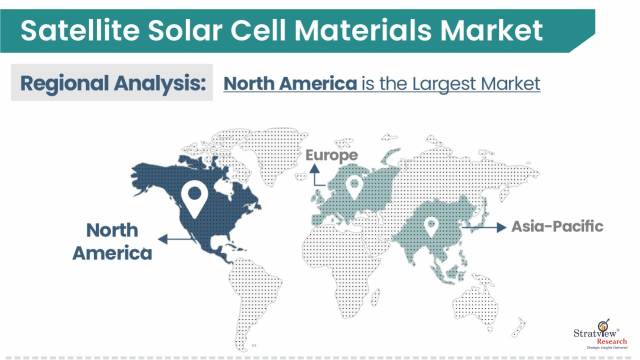
North America is expected to be the dominant and fastest-growing region over the forecasted period. |
"The Gallium Arsenide segment is projected to be the dominant segment during the forecast period.”
“Satellite segment is expected to be the fastest-growing segment during the forecast period.”
“North America is expected to be the dominant and fastest-growing region over the forecasted period.”
Know the high-growth countries in this report. Register Here
Most of the major players compete in some of the factors, including price, service offerings, regional presence, etc. The following are the key players in the satellite solar cell materials market:
Note: The above list does not necessarily include all the top players in the market.
Are you a leading player in this market? We would love to include your name. Please write to us at [email protected]
This report provides market intelligence most comprehensively. The report structure has been kept so that it offers maximum business value. It provides critical insights into market dynamics and will enable strategic decision-making for existing market players as well as those willing to enter the market.
The following are the key features of the report:
|
Market Study Period |
2019-2032 |
|
Base Year |
2024 |
|
Forecast Period |
2025-2032 |
|
Trend Period |
2019-2023 |
|
Number of Tables & Figures |
>100 |
|
Number of Segments Analysed |
6 (Material Type, Orbit Type, Application Type, Tracking Type, Component Type, and Region) |
|
Number of Regions Analysed |
4 (North America, Europe, Asia-Pacific, Rest of the World) |
|
Countries Analysed |
15 (The USA, Canada, Mexico, Germany, France, Italy, The UK, China, Japan, India, Brazil, Saudi Arabia, Rest of Europe, Rest of APAC, and Rest of the World) |
|
Free Customization Offered |
10% |
|
After Sales Support |
Unlimited |
|
Report Presentation |
Complimentary |
|
Market Dataset |
Complimentary |
|
Further Deep Dive & Consulting Services |
10% Discount |
This report studies the market, covering a period of 15 years of trend and forecast. The report provides detailed insights into the market dynamics to enable informed business decision-making and growth strategy formulation based on the opportunities present in the market.
The satellite solar cell materials market is segmented into the following categories:
By Material Type
By Orbit Type
By Application Type
By Region
With this detailed report, Stratview Research offers one of the following free customization options to our respected clients:
Company Profiling
Competitive Benchmarking
Custom Research: Stratview Research offers custom research services across industries. In case of any custom research requirement related to market assessment, competitive benchmarking, sourcing and procurement, target screening, and others, please send your inquiry to [email protected].
The report is delivered digitally through our online portal. Buyers receive login credentials from our team to access the report and may update their credentials at any time after the initial login.
Delivery timelines depend on the status of the report:
For the most accurate delivery timeline, please contact us to confirm the current status of the report.
Yes. You may request a complimentary preview of the report through a video conference with our team.
Yes. The scope of the report can be fully customized to align with your specific research objectives and information requirements.
Please contact us at [email protected], and our team will be happy to discuss your requirements and propose a tailored solution.
Yes. Selected sections of the report can be purchased separately based on your requirements. Please contact us at [email protected] to discuss your needs.
Yes, AI can help gather publicly available information, but its outputs are only as reliable as the data it accesses. Stratview Research reports are built using validated data, extensive primary interviews with industry stakeholders, and the expertise of our experienced research team.
Additionally, many critical insights, including market dynamics, competitive intelligence, and industry-specific trends, are not publicly available and therefore cannot be captured through AI alone.
Satellite solar cell materials are purpose-designed materials applied in the production of solar cells intended to provide electrical power for satellites and other space systems. These materials need to be resistant to harsh space environmental conditions like high radiation, temperature variations, and micrometeoroid impacts while ensuring high energy efficiency and long-term reliability.
The forecasted value for the market is US$123.81 million in 2032.
Satellite solar cell materials market size was USD 43.9 million in 2024 and is expected to grow from USD 50.13 million in 2025 to USD 123.81 million in 2032, witnessing an impressive market growth (CAGR) of 13.79% during the forecast period (2025-2032).
The key drivers of the satellite solar cell materials market include a surge in satellite deployments and space exploration, government investments and strategic initiatives, and regional growth of space infrastructure in North America.
The top players in the satellite solar cell materials market include • Spectrolab (US) • Azur Space Solar Power GMBH (Germany) • Rocket Lab (US) • Sharp Corporation (Japan) • Cesi S.P.A. (Italy)
North America is expected to be the dominant and the fastest-growing region of the satellite solar cell materials market over the forecasted period, due to expanding satellite hubs, growing energy demand, and rising automotive production.


WE ACCEPT


