



404
+1-313-307-4176

Harmonic Filter Market Analysis | 2018-2023

Harmonic Filter Market Size, Share, Trends, Dynamics, Forecast, & Growth Analysis: 2018-2023
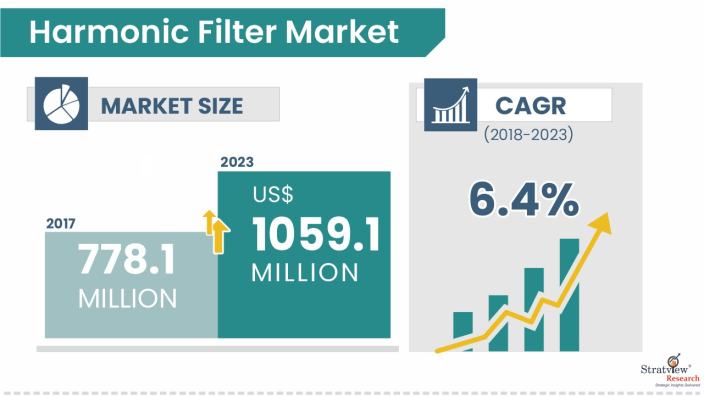
The harmonic filter market was estimated at USD 778.1 million in 2017 and is likely to grow at a CAGR of 6.4% during 2018-2023 to reach USD 1,059.1 million in 2023.
Want to know more about the market scope? Register Here
A harmonic filter is a device that mitigates harmonics to tolerable levels. Heavy electric machines generate huge non-linear loads, which create many harmonics in the electrical power system. Harmonics are periodic, sinusoidal, and integer multiples of the fundamental frequency (50Hz or 60Hz), current, or voltage components present in the non-sinusoidal waveform. Non-linear loads are the root cause of harmonic generation.
Heavy industrial applications, such as arc furnaces, large variable frequency drives (VFDs), and heavy rectifiers for electrolytic refining, generate a lot of harmonics due to significant non-linear loads. A harmonic filter is the most suitable component that safeguards electronics and improves the power quality factor. Nowadays, in addition to industrial applications, various commercial applications, such as data and IT centers, hospitals, and commercial complexes, are also creating a huge concern about mitigating harmonic distortions.
The key factors propelling the growth of harmonic filters are listed below.
It is increasing the use of power electronics that operate through electronic switching.
Increasing levels of harmonic distortions of voltage and current waveforms in power systems.
Increasing usage of variable frequency drives (VFDs).
Rising demand from the data centers and IT industries.
An increasing number of metal arc furnaces worldwide.
Increasing concern for potential damage from power frequency variations.
Increasing use of sensitive electronics in the industrial automation process.
|
Segmentations |
List of Sub-Segments |
Dominant and Fastest-Growing Segments |
|
Filter-Type Analysis |
Active Harmonic Filter and Passive Harmonic Filter |
The passive harmonic filter is likely to remain the most dominant filter type during the forecast period. |
|
Voltage Level-Type Analysis |
Low-Voltage Harmonic Filter, Medium-Voltage Harmonic Filter, and High-Voltage Harmonic Filter |
Low-voltage harmonic filter is projected to remain the largest segment of the market during the forecast period. |
|
Phase-Type Analysis |
Single-Phase Harmonic Filter and Three-Phase Harmonic Filter |
Three-phase harmonic filter is projected to maintain its dominance in the market over the next five years. |
|
End-User-Type Analysis |
Manufacturing, Metal Processing, Pulp & Paper, Data & IT Center, Oil & Gas, and Others |
The manufacturing segment is likely to remain the most dominant end-user type in the market during the forecast period. |
|
Regional Analysis |
North America, Europe, Asia-Pacific, and Rest of the World |
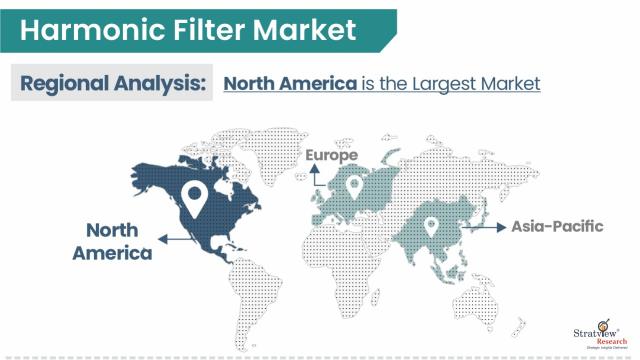
North America is projected to remain the largest harmonic filter market during the forecast period. |
"The passive harmonic filters segment accounted for the largest market share."
The market is segmented into passive harmonic filters and active harmonic filters. The passive harmonic filter is likely to remain the most dominant filter type during the forecast period. Passive filters are most suitable for constant loads, as they eliminate or bypass lower-order fixed harmonics of current or voltage by tuning them at the resonance frequency.
However, the active harmonic filter is likely to be the fastest-growing filter type segment of the market, owing to its superior harmonic elimination factor as it doesn’t get easily overloaded even if it reaches its limit.
"The low-voltage segment accounted for the largest market share."
The harmonic filters market is segmented into low-voltage, medium-voltage, and high-voltage harmonic filters. Low-voltage harmonic filter is projected to remain the largest segment of the market during the forecast period.
Whereas, the medium-voltage harmonic filter, another considerable segment, is likely to grow at an impressive rate in the market during the same period.
"The three-phase harmonic filters segment accounted for the largest market share."
The market is segmented into single-phase harmonic filters and three-phase harmonic filters. Three-phase harmonic filter is projected to maintain its dominance in the market over the next five years. The segment is also likely to grow at an impressive rate in the market during the same period, owing to its diversified usage in high-end industrial applications, such as manufacturing and metal processing, as well as in commercial applications, such as data and IT centers, malls, and airports.
"The manufacturing segment accounted for the largest market share."
The market is classified as manufacturing, metal processing, paper & pulp, data & IT centers, oil & gas, and others. The manufacturing segment is likely to remain the most dominant end-user type in the market during the forecast period. The manufacturing segment majorly includes cement, pharmaceutical, power plants, steel, foundries, and chemical industries.
The industrial sector is the major generator of variable speed drives (VSDs) to which manufacturing is a big contributor. VSDs inject harmonics and create a power-quality problem in industrial power-supply distribution.
"North America accounted for the largest market share."
North America is projected to remain the largest harmonic filter market during the forecast period. The USA is the growth engine of the North American market, driven by the presence of major players in harmonic filters as well as end-use industries. Asia-Pacific is likely to be the fastest-growing harmonic filter market during the forecast period, driven by China, India, and Japan.
Know the high-growth countries in this report. Register Here
The market is highly populated with the presence of several local, regional, and global players. The supply chain of this market comprises raw material suppliers, component manufacturers, harmonic filter manufacturers, distributors, and end users.
The following are the key players in the harmonic filters market (arranged alphabetically).
Note: The above list does not necessarily include all the top players in the market.
Are you the leading player in this market? We would love to include your name. Write to us at [email protected].
This report provides market intelligence in the most comprehensive way. The report structure has been kept such that it offers maximum business value. It provides critical insights into market dynamics and will enable strategic decision-making for existing market players as well as those willing to enter the market. The following are the key features of the report:
This report studies the market, covering a period of 12 years of trends and forecasts. The report provides detailed insights into the market dynamics to enable informed business decision-making and growth strategy formulation based on the opportunities present in the market.
The harmonic filter market is segmented into the following categories:
By Filter Type
By Voltage Level Type
By Phase Type
By End-User Type
By Region
This strategic assessment report, from Stratview Research, provides a comprehensive analysis that reflects today’s harmonic filter market realities and future market possibilities for the forecast period of 2018 to 2023. After a continuous interest in our harmonic filter market report from the industry stakeholders, we have tried to further accentuate our research scope to the harmonic filter market to provide the most crystal-clear picture of the market. The report segments and analyses the market in the most detailed manner to provide a panoramic view of the market. The vital data/information provided in the report can play a crucial role for the market participants as well as investors in the identification of the low-hanging fruits available in the market as well as to formulate the growth strategies to expedite their growth process.
This report offers high-quality insights and is the outcome of a detailed research methodology comprising extensive secondary research, rigorous primary interviews with industry stakeholders, and validation and triangulation with Stratview Research’s internal database and statistical tools. More than 1000 authenticated secondary sources, such as company annual reports, fact books, press releases, journals, investor presentations, white papers, patents, and articles, have been leveraged to gather the data. We conducted more than 15 detailed primary interviews with the market players across the value chain in all four regions and industry experts to obtain both qualitative and quantitative insights.
With this detailed report, Stratview Research offers one of the following free customization options to our respectable clients:
Company Profiling
Competitive Benchmarking
Custom Research: Stratview Research offers custom research services across sectors. In case of any custom research requirement related to market assessment, competitive benchmarking, sourcing and procurement, target screening, and others, please send your inquiry to [email protected].
A harmonic filter is a device that mitigates harmonics to tolerable levels. Heavy electric machines generate huge non-linear loads, which create many harmonics in the electrical power system. Harmonics are periodic, sinusoidal, and integer multiples of the fundamental frequency (50Hz or 60Hz), current, or voltage components present in the non-sinusoidal waveform. Non-linear loads are the root cause of harmonic generation.
The harmonic filter market was estimated at USD 778.1 million in 2017.
The forecasted value of the harmonic filter market is expected to be USD 1,059.1 million in 2023.
The harmonic filter market is likely to grow at a CAGR of 6.4% during 2018-2023.
ABB Ltd., Schneider Electric SA, Eaton Corporation Plc, Danfoss Group, Schaffner Holding AG, Siemens AG, TDK Corporation, AVX Corporation, Comsys AB, and TCI, LLC. are among the key players in the market.
Passive harmonic filter is expected to remain dominant in the market during the next five years.
North America is projected to remain the largest market during the forecast period.
The growth of the harmonic filters market was driven by the rise of industrial automation, global adoption of renewable energy systems, growing demand for power quality and management, and rising demand from the data centers and IT industries.


WE ACCEPT