


404
+1-313-307-4176

Ceiling Tiles Market Analysis | 2024-2030

Ceiling Tiles Market Size, Share, Trends, Dynamics, Forecast, & Growth Analysis: 2024-2030
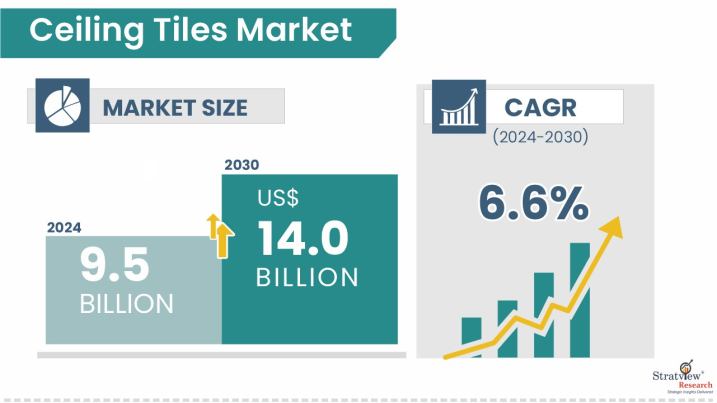
The ceiling tiles market value was USD 9.5 billion in 2024 and is likely to grow at a CAGR of 6.6% during 2024-2030 to reach USD 14.0 billion in 2030.
Want to know more about the market scope? Register Here
Ceiling tiles are commonly considered the most important interior design items that have practical functions and aesthetic value. These tiles are useful in improving the acoustics, fire rating, and insulation. It is used in most commercial buildings, schools, and health facilities because they are a cheap way to change the interior designs. Ceiling tiles are available in different designs, textures, and colors; thus, one can always have ceiling tiles that they want while meeting their need at the same time. Moreover, they can cover wiring pipes and ducts and other related structures thus helping in having a neat and presentable outlook.
A huge number of strategic alliances including M&As, JVs, etc. have been performed over the past few years:
|
Segmentations |
List of Sub-Segments |
Segments with High Growth Opportunity |
|
Material Analysis |
Mineral Fiber, Metal, Gypsum, and Others (Wood Ceiling Tiles, Composite Ceiling Tiles, and Plastic Ceiling Tiles). |
Mineral Fiber is said to be the dominating material in the market for ceiling tiles market. |
|
Property Analysis |
Acoustic and non-acoustic. |
Acoustic is said to be dominating the market for ceiling tiles market. |
|
End User Analysis |
Non-residential (Institutions, Hospitals and Offices) and Residential. |
Non-residential is said to be dominated by end-users of the ceiling tile market. |
|
Region Analysis |
Asia-Pacific, Europe, North America, and The Rest of the World. |
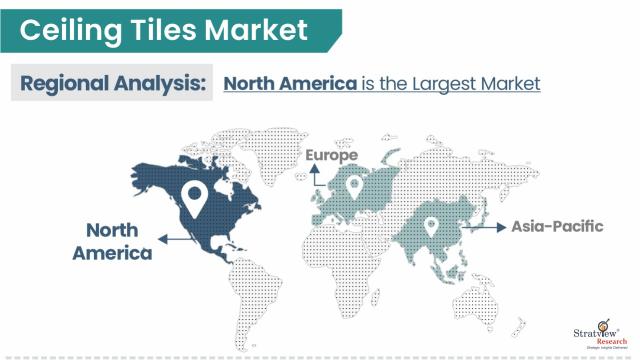
North America is the largest whereas, Asia-Pacific is the fastest-growing region for the ceiling tiles market. |
“Mineral Fiber is said to be dominating the material of the market during the forecast period”.
“Acoustic is said to be dominating the market during the forecast period”.
“Non-Residential is said to be dominating by end-user of the market during the forecast period”.
“North America is the largest whereas, Asia-Pacific is the fastest-growing region of the ceiling tiles market for ceiling tiles during the forecast period”.
Know the high-growth countries in this report. Register Here
The market is partially fragmented across the region. Most of the major players compete in some of the governing factors including price, service offerings, regional presence, etc. The following are the key players in the ceiling tiles market:
Here is the list of the Top Players (Based on Dominance)
Note: The above list does not necessarily include all the top players in the market.
Are you the leading player in this market? We would love to include your name. Write to us at [email protected]
This report provides market intelligence most comprehensively. The report structure has been kept such that it offers maximum business value. It provides critical insights into market dynamics and will enable strategic decision-making for existing market players as well as those willing to enter the market. The following are the key features of the report:
This report studies the market, covering a period of 12 years of trends and forecasts. The report provides detailed insights into the market dynamics to enable informed business decision-making and growth strategy formulation based on the opportunities present in the market.
The ceiling tiles market is segmented into the following categories.
By Material Type
By Property Type
By End User Type
By Region
With this detailed report, Stratview Research offers one of the following free customization options to our respectable clients:
Company Profiling
Competitive Benchmarking
Custom Research: Stratview Research offers custom research services across sectors. In case of any custom research requirement related to market assessment, competitive benchmarking, sourcing and procurement, target screening, and others, please send your inquiry to [email protected].
Ceiling tiles are predefined structural materials used for constructing the ceilings of residential, commercial, and industrial entities. Available in different types including mineral fiber, metal, gypsum, wood, composite, and plastic types. The primary functions of ceiling tiles are the aesthetic aspect as well as noise control, insulation, and fire retardance. They are frequently located in a matrix pattern where they provide accessibility to the plenum zone above for the serviceability of electrical, piping, and mechanical systems.
The forecasted value of the ceiling tiles market is expected to reach USD 14.0 billion by 2030.
The ceiling tiles market is estimated to grow at a CAGR of 6.6% by 2030, because of factors such as the development in urban populations, construction projects’ expansion, and awareness regarding green and energy-saving construction products. The growth of new technologies in the materials used in the production of ceiling tiles and designs, an increase in disposable income per capita, and a better standard of living are also the major growth factors for the market. Further, the regulation and standards for constructing safer, better quality, acoustically superior, and energy-efficient buildings, are also influencing the market for sophisticated ceiling tile products.
The main market drivers are the urbanization and construction boom, focus on sustainability and technological advancements.
North America has the largest market share of ceiling tiles because it has a well-developed construction industry and a high tendency for renovation and remodeling projects. High performance and regulatory standards for constructing buildings in the region call for high-performance building materials which include advanced ceiling tiles. Moreover, the availability of the leading market participants and the concurrent product development contribute to the same factor strengthening North America. Offices, healthcare centers, and schools, which collectively constitute a large part of the commercial segment, are the primary drivers of ceiling tile demand in the area.
Saint-Gobain S.A., Armstrong World Industries, Inc., Gebr. Knauf KG, Hunter Douglas, KET Ceilings, Aerolite Industries Pvt. Ltd., Rockfon, Odenwald Faserplattenwerk GmbH, Georgia-Pacific, and SAS International are the leading players in the ceiling tiles market.
Mineral fiber is the leading segment by material type because of its better sound insulation feature, reasonable price, and fire resistance. These tiles are efficient in sound insulation hence appropriate where noise control is desirable including; offices, schools, or health-related facilities. The material is also naturally flame retardant which is very useful in avoiding accidents commonly emerging from fire and saving the building from non-conforming to the building codes. Furthermore, it can be noted that mineral fiber tiles are not expensive as compared to other materials, hence their use for large projects.
The non-residential sector is the leading segment by end users as these products are widely used in commercial, institutional, and Industrial structures. In such environments, the need for ceiling tiles is thereby perceived in the aspect of providing sound absorption, aesthetics, and fire resistance. Offices, schools, hospitals, places selling goods, and industries necessitate special types of ceilings to perform certain optimal functions. This also creates a large volume of demand for ceiling tiles for large-scale projects as these serve different functions in places like the working station, class, corridors, and lobby among others. Secondly, the non-residential market is proportional to construction and reconstruction works for the improvement of the existing facilities and the construction of new buildings.


WE ACCEPT


