


404
+1-313-307-4176

Nanorobotics Market Analysis | 2023-2029

Nanorobotics Market Size, Share, Trends, Dynamics, Forecast, & Growth Analysis: 2023-2029
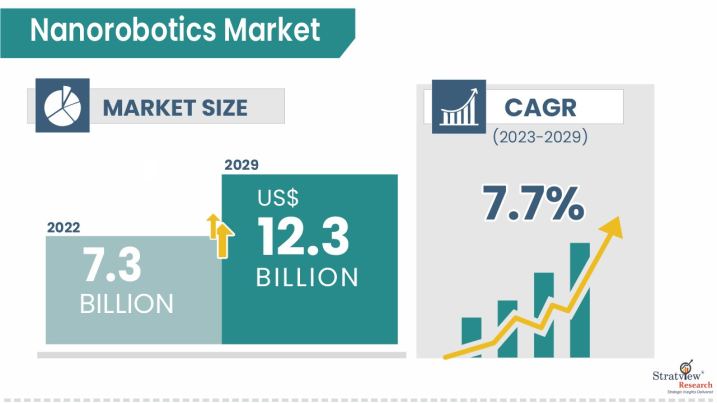
The nanorobotics market was estimated at USD 7.3 billion in 2022 and is likely to grow at a CAGR of 7.7% during 2023-2029 to reach USD 12.3 billion in 2029.
Want to know more about the market scope? Register Here
Nanorobotics is a field of robotics that involves the design, manufacture, and operation of robots at the nanoscale level, typically with sizes ranging from 0.1 to 10 micrometers. These robots are also referred to as nanobots or nanomachines and are typically made from materials such as DNA, proteins, or carbon nanotubes.
The applications of nanorobotics are wide-ranging, including medicine, electronics, and manufacturing. In medicine, nanorobots have the potential to revolutionize the way diseases are diagnosed and treated, with applications such as targeted drug delivery, cancer therapy, and even surgical procedures at the cellular level.
In electronics and manufacturing, nanorobots can be used for tasks such as assembly, quality control, and even self-replication. The development of nanorobots is still in its early stages, but it holds tremendous potential for the future of technology and innovation.
The challenges of nanorobotics include the development of new materials and manufacturing techniques that can create robots at the nanoscale level, as well as the control and communication with these robots at such a small size. However, the potential benefits of this field are significant, and research in this area continues to expand.
Tiny robots known as nanobots can be introduced into a patient's body via injection to conduct diagnosis or treatment at the cellular level. These diagnosis and treatment methods involve working on a nanoscale, molecular, or atomic level. Using nanorobots for treatment may involve modifying the composition and structure at the molecular or submolecular level. Different fields that apply nanorobot technology make use of the distinctive characteristics of materials and devices at the nanoscale level.
Nanobots are a rapidly developing field that holds immense promise as a drug delivery method. The ability to target hard-to-reach areas of the body while transporting medicinal compounds is a highly desirable biomedical application. While there is still much progress to be made in this area, prior research suggests that nanobots will play a crucial role in the fight against challenging diseases. Nonetheless, one of the major challenges that researchers face is ensuring the feasibility of their concepts at the nanoscale.
In recent years, numerous startups have shown interest in this burgeoning field. Pumeram, a Prague-based startup, is one such company that has raised EUR 11.5 million to create nanobots in a range of shapes such as rockets, spheroids, and even screws. These nanobots are being developed to address various medical conditions, including skin and oral disorders, as well as fertility problems. The startup has already tested its cancer-fighting nanobots on mice with successful results.
Google, a tech giant, and GlaxoSmithKline, a major pharmaceutical company, have formed a powerful partnership to explore the potential of nanorobotics in the future. Researchers worldwide have been working since 2020 to develop sophisticated nanobots capable of performing a diverse range of surgical procedures on humans. These nanobots will be programmed and controlled using external magnetic fields. They can carry out eye surgeries with precision needles, clear blocked arteries by drilling a corkscrew through arterial blockages, and collect biopsies.
In late 2019, when the coronavirus outbreak first emerged, researchers began urgently studying SARS-CoV-2, a strain of the coronavirus family known for its crown-like shape. As part of this research, various scientists suggested using nanoparticles that are roughly the same size as the virus that causes COVID-19. These nanoparticles could attach themselves to the SARS-CoV-2 virus, disrupting its structure with a combination of infrared light treatment, leading to a surge in market growth.
Despite the growth potential in the nanorobotics market, there are several restraints that could limit its growth in the future. One of the significant restraints is the high cost of developing and manufacturing nanorobots. The use of advanced technology and the need for specialized manufacturing facilities and equipment increases the overall cost of production. As a result, the prices of nanorobots remain high, making it difficult for smaller companies and medical institutions to afford them.
Another restraint is the lack of proper regulations for the use of nanorobots in the healthcare industry. As nanorobots are a new technology, there are no established regulatory frameworks to ensure their safety and efficacy. The lack of regulations creates uncertainties for manufacturers and healthcare professionals, which could limit the adoption of nanorobots in medical applications.
Moreover, the ethical implications of using nanorobots in medical treatments could also limit their growth. The use of nanorobots raises concerns over issues such as patient privacy, informed consent, and possible misuse of the technology.
Finally, the limited knowledge and understanding of the interaction between nanorobots and biological systems could also be a restraint. While nanorobots show great promise in medical applications, their interaction with biological systems is complex and not yet fully understood. Further research and development are needed to fully realize the potential of nanorobots in medical treatments.
|
Segmentations |
List of Sub-Segments |
Segments with High Growth Opportunity |
|
Type Analysis |
Nanomanipulator, Bio-Nanorobotics, Magnetically Guided, Bacteria-Based |
Nanomanipulator type to hold the largest share of the nanorobotics market, by type, during the forecast period. |
|
Application Type Analysis |
Nanomedicine, Biomedical, Mechanical |
A large level of commercialization in the healthcare sector is expected to drive market growth for nanomedicine in the nanorobotics market during the forecast period. |
|
Regional Analysis |
North America, Europe, Asia-Pacific, and the Rest of the World |
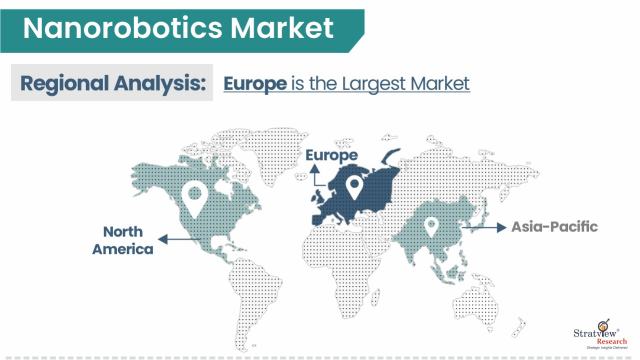
Europe is expected to exhibit the highest Compound Annual Growth Rate (CAGR) during the forecast period. |
Nanomanipulator type to hold the largest share of the nanorobotics market, by type, during the forecast period. Nanomanipulators are the pioneering nanorobotic systems with the ability to perform nanopositioning. Initially used in physics and chemistry, nanomanipulators involve robotics in nanomanipulation for the development of various nanomanipulation systems.
These systems exhibit similar capabilities to industrial manipulators. In nanorobotics, nanomanipulators are primarily employed to manipulate atoms and molecules and were among the first commercially available nanorobotic systems.
A large level of commercialization in the healthcare sector is expected to drive market growth for nanomedicine in the nanorobotics market during the forecast period. Nanorobotics is extensively employed in the field of nanomedicine due to its healthcare-related features. In 2022, nanomedicine dominated the overall nanorobotics market in terms of application.
This dominance can be attributed to the significant level of commercialization in the healthcare sector for various applications, including drug delivery, biomaterials, in vivo imaging, in vitro diagnostics, active implants, and drug therapy. The market for biomedical applications held the second-largest share of the overall market, in terms of application, in 2022.
During the forecast period, the nanorobotics market in Europe is expected to exhibit the highest Compound Annual Growth Rate (CAGR). This growth can be attributed to the rising aging population and increasing governmental expenditure on healthcare in the region.
Furthermore, Europe was among the first regions to recognize the potential of nanorobotics, resulting in high levels of public and private funding that contribute to the growth of the nanorobotics market in Europe. The market in the Asia Pacific follows Europe closely in terms of CAGR and is expected to witness the second-highest growth rate among all regions in the overall nanorobotics market.
The North American region is expected to hold a significant share of the nanorobotics market during the forecast period. This growth can be attributed to the considerable support for nanorobotics from the Defense Advanced Research Projects Agency (DARPA) and the National Science Foundation (NSF) in the region.
Additionally, the growth in the adoption of nanotechnology, along with high healthcare expenditure, is expected to have a positive impact on the market in North America.
Know the high-growth countries in this report. Register Here
The major players operating in the nanorobotics market are:
Note: The above list does not necessarily include all the top players in the market.
Are you the leading player in this market? We would love to include your name. Write to us at [email protected]
This strategic assessment report, from Stratview Research, provides a comprehensive analysis that reflects today’s nanorobotics market realities and future market possibilities for the forecast period of 2023 to 2029. After a continuous interest in our nanorobotics market report from the industry stakeholders, we have tried to further accentuate our research scope to the nanorobotics market to provide the most crystal-clear picture of the market. The report segments and analyzes the market in the most detailed manner to provide a panoramic view of the market. The vital data/information provided in the report can play a crucial role for the market participants as well as investors in the identification of the low-hanging fruit available in the market, as well as to formulate the growth strategies to expedite their growth process.
This report offers high-quality insights and is the outcome of a detailed research methodology comprising extensive secondary research, rigorous primary interviews with industry stakeholders, and validation and triangulation with Stratview Research’s internal database and statistical tools. More than 1000 authenticated secondary sources, such as company annual reports, fact books, press releases, journals, investor presentations, white papers, patents, and articles, have been leveraged to gather the data. We conducted more than 15 detailed primary interviews with the market players across the value chain in all four regions and industry experts to obtain both qualitative and quantitative insights.
This report provides market intelligence in the most comprehensive way. The report structure has been kept such that it offers maximum business value. It provides critical insights into market dynamics and will enable strategic decision-making for existing market players as well as those willing to enter the market. The following are the key features of the report:
This report studies the market, covering a period of 12 years of trends and forecasts. The report provides detailed insights into the market dynamics to enable informed business decision-making and growth strategy formulation based on the opportunities present in the market.
The nanorobotics market is segmented into the following categories:
By Type
By Application Type
By Region
With this detailed report, Stratview Research offers one of the following free customization options to our respected clients:
Company Profiling
Competitive Benchmarking
Custom Research: Stratview Research offers custom research services across the sectors. In case of any custom research requirement related to market assessment, competitive benchmarking, sourcing and procurement, target screening, and others, please send your inquiry to [email protected].
Nanorobotics is a field of robotics that involves the design, manufacture, and operation of robots at the nanoscale level, typically with sizes ranging from 0.1 to 10 micrometers. These robots are also referred to as nanobots or nanomachines and are typically made from materials such as DNA, proteins, or carbon nanotubes.
The nanorobotics market was estimated at USD 7.3 billion in 2022.
The forecasted value of the nanorobotics market is expected to be USD 12.3 billion in 2029.
The nanorobotics market is likely to grow at a CAGR of 7.7% during 2023-2029.
The major players operating in the global market are Thermo Fisher Scientific, Bruker, JEOL, Ginkgo Bioworks, Oxford Instruments, Imina Technologies, Toronto Nano Instrumentation, EV Group, Klocke Nanotechnik, Kleindiek Nanotechnik, Xidex, Synthace, Smaract, Nanonics Imaging, Park Systems.
During the forecast period, the nanorobotics market in Europe is expected to exhibit the highest Compound Annual Growth Rate (CAGR). This growth can be attributed to the rising aging population and increasing governmental expenditure on healthcare in the region.
A large level of commercialization in the healthcare sector is expected to drive market growth for nanomedicine in the nanorobotics market during the forecast period. Nanorobotics is extensively employed in the field of nanomedicine due to its healthcare-related features. In 2022, nanomedicine dominated the overall nanorobotics market in terms of application.


WE ACCEPT


