



404
+1-313-307-4176

IoT in Banking and Financial Services Market Analysis | 2022-2028

IoT in Banking and Financial Services Market Size, Share, Trends, Dynamics, Forecast, & Growth Analysis: 2022-2028
The IoT in banking and financial services market was estimated at USD 414.6 million in 2021 and is likely to grow at a CAGR of 41.1% during 2022-2028 to reach USD 4,606.2 million in 2028.

Want to know more about the market scope? Register Here
IoT gives a wide range of digitalization advantages to BFSI from 360-degree customer view to increased financial security, fraud detection, advanced insurance strategies, and more. IoT in BFSI optimizes their services and operations. IoT plays an important role in banking and finance services by ensuring systematic data collection and processing and supporting the digital automation of key processes. IoT in the banking and financial sector helps to improve customer service, security, and management.
IoT helps finance companies by saving time and money and also by collecting and transferring data efficiently. Banks use IoT technology to gather appropriate data to grasp various banking processes. IoT can help banks and financial organizations by strengthening present procedures and also by integrating innovative plans.
In today’s world, IoT has evolved as the most advanced and ubiquitous technological innovation of the century. With the development of digitally connected devices, industrial sectors such as telecom, manufacturing, energy and utility, IT, healthcare, logistics, BFSI, aerospace and defense, media and entertainment, and government are expected to experience an upsurge in digital services. Within the BFSI sector, IoT is anticipated to have a tremendous impact on all aspects.
IoT enables financial institutions to monitor customers’ activities, needs, and life events using the data generated by sensors. Furthermore, IoT enables financial institutions to deliver usage-based differentiated offerings, and impact the financial decision-making of individuals.
The IoT and its capabilities to create a connected ecosystem for banking services arose as a result of technological developments, growing demand for its application, and, thus, driving the market growth. Moreover, the growing number of data breaches tends to drive the need for such developments. Moreover, the consistency of growth in IT and OT adds to the market’s positive outlook.
Using IoT devices, banks, and financial institutions can give holistic and connected solutions for customer finances in real-time. These IoT-based connected banking solutions help banks fulfill the needs of customers using the data collected from different smart devices to facilitate smart financial decisions. The customer data also helps banks give financial assistance, value-added services, and customized products to individual customers.
Furthermore, it helps banks reduce operations costs, because of the increased user and IT productivity and the decreased technology costs. For instance, a UK-based multinational bank implemented Capgemini’s Connected Banking solution to discontinue its legacy core banking system, decrease operational costs, and achieve the agility required to deliver customer-centric banking services.
The connectivity problem between IoT devices and products is one of the major restraining factors for all enterprises and their clients, as enterprises’ current systems do not fulfill the global connectivity standards. Interoperability is often seen as being central to the success of the products and services that use IoT technology. Another crucial aspect of IoT enablement is the consistent interoperability among connections, wherein solution providers share an interest in using standards that promote IoT advancement and interoperability.
Financial institutions seek the competitive and economic benefits of building exclusive IoT systems that are based on proprietary standards and protocols. Communication protocols and standards can be used to ensure interoperability among heterogeneous hardware and software platforms and systems.
Presently, data is continuously collected through smartphones, smartwatches, smart devices, sports trackers, and even smart houses. All these devices generate a continuous flow of data that are to be stored, processed, and analyzed to bring value. Furthermore, this data can further be used for real-time data processing which can enable organizations to enhance their productivity and improve business operations.
It can also enable service providers to leverage the generated data for marketing campaign effectiveness analysis, research, and other proactive solutions. In the BFSI vertical, real-time data flow can be leveraged for fraud detection, risk management, transaction cost analysis, and application monitoring. Moreover, real-time data processing can also prevent finance-related issues such as stock exchange meltdowns and risky trades.
Data migration is an important component to consider while seeking any new system, either through integration with a new system or a new deployment. Migrating data from old legacy systems to new systems, and the resources required in the migration process increase the enterprises’ operational costs.
Furthermore, data migration causes serious problems if the system design and process coordination are not carried out properly, business rules are incorrectly interpreted, or data standardization is not properly followed. In addition to this, it is challenging to transfer unstructured data, as it needs to be cleaned and reviewed properly before processing.
Moreover, the major issues during data migration are the completion of the process within the specified deadline and the removal of risks associated with it, as most data migration projects struggle with implementation delays. As maintaining the data quality is also a critical factor in data migration, a lot of planning is done before initiating the data migration process.
The monitoring solution has effectively decreased the error resolution time by providing precise information about a failure’s occurrence to the financial institutions, thereby accelerating the overall growth of the IoT in banking and financial services market.
By service, the professional services segment is expected to have the largest market share over the forecast period. Its high growth rate can be attributed to the increased complexity of operations and the increasing adoption of IoT solutions among enterprises.
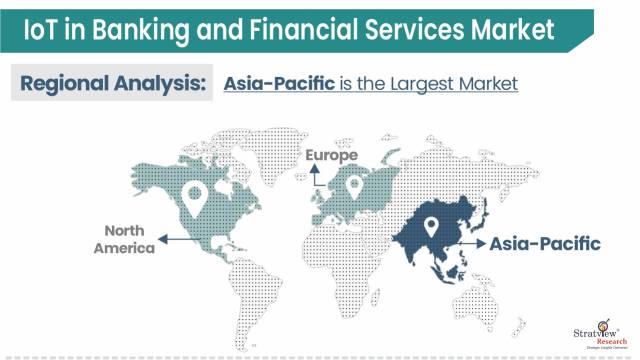
Asia Pacific is one of the early adopters of IoT technologies and thus it is expected to hold the largest market share of the IoT in banking and financial services market as well as grow with the highest CAGR over the forecast period.
Know the high-growth countries in this report. Register Here
The major players operating in the global IoT in banking and financial services market are:
Note: The above list does not necessarily include all the top players in the market.
Are you the leading player in this market? We would love to include your name. Write to us at [email protected]
This strategic assessment report, from Stratview Research, provides a comprehensive analysis that reflects today’s IoT in banking and financial services market realities and future market possibilities for the forecast period of 2022 to 2028. After a continuous interest in our IoT in banking and financial services market report from the industry stakeholders, we have tried to further accentuate our research scope to the IoT in banking and financial services market to provide the most crystal-clear picture of the market. The report segments and analyses the market in the most detailed manner to provide a panoramic view of the market. The vital data/information provided in the report can play a crucial role for the market participants as well as investors in the identification of the low-hanging fruits available in the market as well as to formulate the growth strategies to expedite their growth process.
This report offers high-quality insights and is the outcome of a detailed research methodology comprising extensive secondary research, rigorous primary interviews with industry stakeholders, and validation and triangulation with Stratview Research’s internal database and statistical tools. More than 1000 authenticated secondary sources, such as company annual reports, fact books, press releases, journals, investor presentations, white papers, patents, and articles, have been leveraged to gather the data. We conducted more than 15 detailed primary interviews with the market players across the value chain in all four regions and industry experts to obtain both qualitative and quantitative insights.
This report provides market intelligence in the most comprehensive way. The report structure has been kept such that it offers maximum business value. It provides critical insights into market dynamics and will enable strategic decision-making for existing market players as well as those willing to enter the market. The following are the key features of the report:
This report studies the market, covering a period of 12 years of trends and forecasts. The report provides detailed insights into the market dynamics to enable informed business decision-making and growth strategy formulation based on the opportunities present in the market.
The IoT in banking and financial services market is segmented into the following categories:
By Component Type
By Solution Type
By Service Type
By End-User Type
By Organization Size Type
By Region
With this detailed report, Stratview Research offers one of the following free customization options to our respectable clients:
Company Profiling
Competitive Benchmarking
Custom Research: Stratview Research offers custom research services across the sectors. In case of any custom research requirement related to market assessment, competitive benchmarking, sourcing and procurement, target screening, and others, please send your inquiry to [email protected].
The IoT in banking and financial services market is likely to grow at a CAGR of 41.1% during 2022-2028.
The IoT in banking and financial services market was estimated at USD 414.6 million in 2021.
The forecasted value of the IoT in banking and financial services market is expected to be USD 4,606.2 million in 2028.
The key players operating in the global market are IBM (US), Capgemini (France), Microsoft (US), Cisco (US), SAP (Germany), Oracle (US), Accenture (Ireland), Software AG (Germany), Infosys (India), Vodafone (UK), Mulesoft, Allerin Technologies, Mindbowser, Ewave Mobile, Zerone Consulting, Hintachi Vantara, Cabot Technology, Tibbo Systems.
Asia Pacific is one of the early adopters of IoT technologies and thus it is expected to hold the largest market share of the IoT in banking and financial services market as well as grow with the highest CAGR over the forecast period.
The IoT and its capabilities to create a connected ecosystem for banking services arose as a result of technological developments, growing demand for its application, and, thus, driving the market growth. Moreover, the growing number of data breaches tends to drive the need for such developments.
The professional services segment is expected to have the largest market share over the forecast period.


WE ACCEPT


