



404
+1-313-307-4176

Heat Meters Market Analysis | 2025-2030

Heat Meters Market Size, Share, Trends, Dynamics, Forecast, & Growth Analysis: 2025-2030
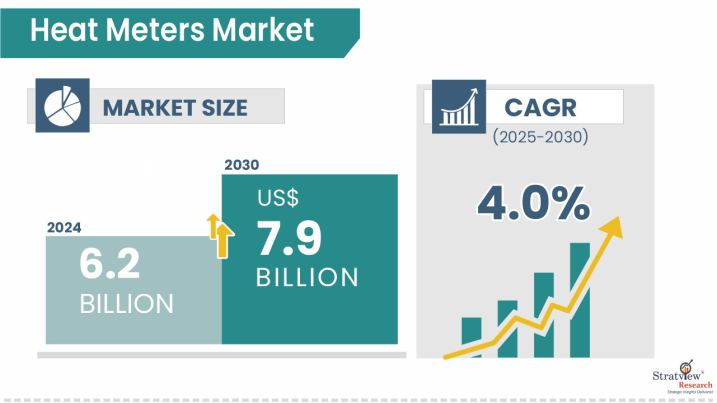
The heat meters market was estimated at USD 6.2 billion in 2024 and is likely to grow at a CAGR of 4% during 2025-2030 to reach USD 7.9 billion in 2030.
Want to know more about the market scope? Register Here
A heat meter is a tool used to gauge the amount of thermal energy emitted by a source. It gauges the fluid's flow rate and the difference in temperature between the outflow and return legs. The three main components of a heat meter are a flow sensor, a calculator, and two temperature sensors. The apparatus is made to work at a nominal flow rate. Most of the time, it can be run at or slightly below this flow rate.
Grid constraints have been caused by high global electricity consumption, and new rules and clean energy sources have added to the complexity. Smart energy meters are emerging as a long-term solution to these issues. This is due to their numerous benefits, which include reduced commercial losses, improved revenue management, and detection of energy theft. Customers who use smart meters can monitor and reduce their energy consumption. Increased government initiatives to meet climate targets and significant spending to increase energy efficiency are the two key trends in the market for heat meters.
According to the IEA Sustainable Recovery Tracker's Autumn 2021 edition, energy efficiency-related investments account for roughly two-thirds of the USD 400 billion per year that governments are expected to mobilize with recovery measures over the next three years.
|
Segmentations |
List of Sub-Segments |
Dominant and Fastest-Growing Segments |
|
Product-Type Analysis |
Ultrasonic, Vortex, and Others |
Ultrasonic is expected to remain the largest and fastest-growing product type in the market during the forecast period. |
|
Technology-Type Analysis |
Mechanical and Static |
Static is expected to remain the dominant technology type in the market during the forecast period. |
|
Application-Type Analysis |
Residential, Commercial [College/University, Office Buildings, Government Buildings, and Others], and Industrial |
Commercial is expected to remain the dominant application type in the market during the forecast period. |
|
Regional Analysis |
North America, Europe, Asia-Pacific, and Rest of the World |
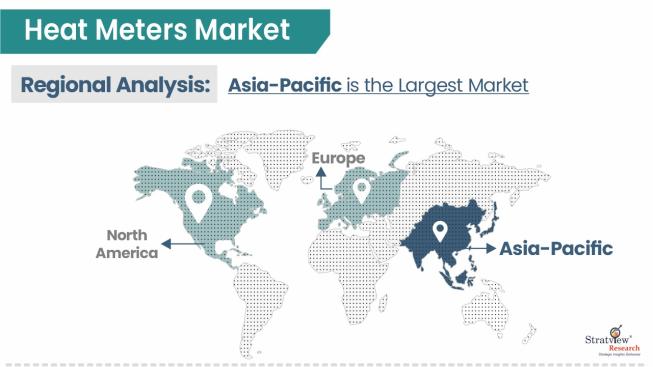
Asia-Pacific is expected to remain the largest market for heat meters during the forecast period. |
The heat meters market is segmented into ultrasonic, vortex, and others. Ultrasonic is expected to remain the largest and fastest-growing product type in the market during the forecast period. Smart technology and energy-efficient systems are becoming increasingly popular. Sustainable and sophisticated heating infrastructure has also rapidly developed to support heat metering systems. Ultrasonic heat meters provide high precision, low energy consumption, and dirt resistance. As consumers shift toward high-tech heating systems that can meet the growing demand for real-time heat consumption monitoring, ultrasonic meters will become more common.
The market is segmented as mechanical and static. Static is expected to remain the dominant technology type in the market during the forecast period. The popularity of effective and sustainable heat management systems that provide real-time data monitoring will drive the market for static heat meters. The market for static heat meters was worth more than USD 3 billion in 2021, owing to significant utilization benefits such as accurate data measurement and adaptable and dependable operations. Furthermore, this technology ensures lower energy consumption, dependable operation, and automated billing systems. The strong preference for smart meters among consumers is expected to drive the demand for static heat meter technology.
The market is segmented as residential, commercial, and industrial. Commercial is expected to remain the dominant application type in the market during the forecast period. Given the rapid pace of global urbanization and industrialization, the commercial sector is expected to generate substantial profits by 2030. Government agencies are investing more and more in effective heat meters in order to reduce greenhouse gas emissions. These factors, along with the growing adoption of personalized billing systems and energy usage management, are likely to increase the demand for heat meters in the commercial sector.
Asia-Pacific is expected to remain the largest market for heat meters during the forecast period. The region's demand for district heating services has increased significantly. Incentives and subsidies are also being implemented by the government to encourage the adoption of automated and sophisticated heating systems. The Asia-Pacific region will become a major hub for the production of heat meters, owing to increased government support and rising investments in heating infrastructure expansion. North America and Europe are also expected to offer sizeable growth opportunities in the coming years.
Know the high-growth countries in this report. Register Here
The market is highly populated with the presence of several local, regional, and global players. Most of the major players compete in some of the governing factors including price, product offerings, regional presence, etc. The following are the key players in the heat meters market:
Note: The above list does not necessarily include all the top players in the market.
Are you the leading player in this market? We would love to include your name. Write to us at [email protected]
This strategic assessment report, from Stratview Research, provides a comprehensive analysis that reflects today’s heat meters market realities and future market possibilities for the forecast period of 2025 to 2030. After a continuous interest in our heat meters market report from the industry stakeholders, we have tried to further accentuate our research scope to the heat meters market to provide the most crystal-clear picture of the market. The report segments and analyses the market in the most detailed manner to provide a panoramic view of the market. The vital data/information provided in the report can play a crucial role for the market participants as well as investors in the identification of the low-hanging fruits available in the market as well as to formulate the growth strategies to expedite their growth process.
This report offers high-quality insights and is the outcome of a detailed research methodology comprising extensive secondary research, rigorous primary interviews with industry stakeholders, and validation and triangulation with Stratview Research’s internal database and statistical tools. More than 1000 authenticated secondary sources, such as company annual reports, fact books, press releases, journals, investor presentations, white papers, patents, and articles, have been leveraged to gather the data. We conducted more than 15 detailed primary interviews with the market players across the value chain in all four regions and industry experts to obtain both qualitative and quantitative insights.
This report provides market intelligence in the most comprehensive way. The report structure has been kept such that it offers maximum business value. It provides critical insights into market dynamics and will enable strategic decision-making for existing market players as well as those willing to enter the market. The following are the key features of the report:
This report studies the market, covering a period of 12 years of trends and forecasts. The report provides detailed insights into the market dynamics to enable informed business decision-making and growth strategy formulation based on the opportunities present in the market.
The heat meters market is segmented into the following categories:
By Product Type
By Technology Type
By Application Type
By Region
With this detailed report, Stratview Research offers one of the following free customization options to our respectable clients:
Company Profiling
Competitive Benchmarking
Custom Research: Stratview Research offers custom research services across the sectors. In case of any custom research requirement related to market assessment, competitive benchmarking, sourcing and procurement, target screening, and others, please send your inquiry to [email protected].
A heat meter is a tool used to gauge the amount of thermal energy emitted by a source. It gauges the fluid's flow rate and the difference in temperature between the outflow and return legs.
The heat meters market was estimated at USD 6.2 billion in 2024.
The forecasted value of the heat meters market is expected to be USD 7.9 billion in 2030.
The heat meters market is likely to grow at a CAGR of 4% during 2025-2030.
The market is driven by increasing government initiatives to meet climate targets and significant spending to increase energy efficiency.
Apator S.A., Danfoss, Landis+Gyr SA, Secure Meters Ltd., Axioma Metering, Saargummi, Micronics Ltd., and Letu Automotive are the leading players in the market.
Asia-Pacific is estimated to remain dominant in the market in the foreseeable future. The region's demand for district heating services has increased significantly. Incentives and subsidies are also being implemented by the government to encourage the adoption of automated and sophisticated heating systems.
Commercial application is expected to maintain its dominance in the market due to the rapid increase in global urbanization and industrialization. By 2030, the commercial sector is expected to generate significant profits.


WE ACCEPT