



404
+1-313-307-4176

Missile Guidance System Market Analysis | 2022-2028

Missile Guidance System Market Size, Share, Trends, Dynamics, Forecast, & Growth Analysis: 2022-2028
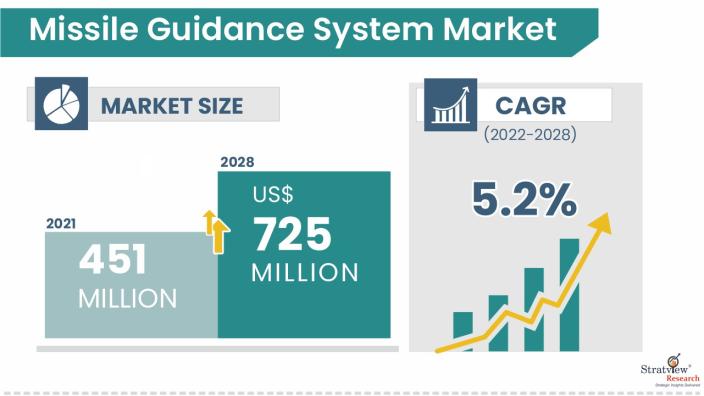
The missile guidance system market was estimated at USD 451 million in 2021 and is likely to grow at a CAGR of 5.2% during 2022-2028 to reach USD 725 million in 2028.
Want to know more about the market scope? Register Here
The electrical and mechanical components of missile guidance systems work together as a whole to steer, control, stabilize, and navigate a missile toward its target. The guiding system uses appropriate techniques to locate the moving target in space and pursues it until it accurately hits the target. The likelihood that a missile will kill in one shot rises when guidance technologies are used (SSKP). These components are found in anti-aircraft, anti-ship, anti-submarine, anti-radiation, and air defense systems missiles.
The market for missile guidance radars is characterized by governments’ efforts to improve their current national security systems, growth in the number of missile system pilot demonstrations, and innovation and the adoption of new technology.
Recently, a sizable number of missile demonstrations have been seen. For instance, the Norwegian Defense Ministry recently completed the development and testing phase of an anti-ship missile system by demonstrating it. The NATO Seasparrow project stated that another successful flight test of the Evolved Seasparrow Missile (ESSM) Block 2 had taken place. India intends to test its Brahmos missiles, the terminal guidance of which is provided by active or passive missile-guiding radar.
The idea of air-search radars is used by missile guidance radar systems to target the intercept regardless of whether the target engages in evasive behavior. A missile's guidance system uses the data it gathers from the target to find it and travel in the desired direction. The six degrees of freedom on the missiles make it simpler for them to alter course. In order to lock on the target, a missile guidance radar employs radar signals sent from the launch vehicle or station and tracks the energy reflected by the target. Altitude control and flight path control are the two control modules used by missile guidance systems.
By regulating the missile's pitch, yaw, and roll, the altitude control system helps the missile maintain its height on the guided flight path. The missile will always go in the target's direction thanks to the combat path control system. The components of a typical guiding subsystem include a receiver, a stability module, a computer, and servo motors. The stabilization unit in the computer divides the guiding signal that the receiver receives from the target into the desired inputs. The signals are then introduced into the servo motors, which modify the missile control surfaces as necessary.
All of the defense systems in use today employ missile-guiding radars. The need for missile-guiding radar systems is rising as developed nations look for improved range capabilities to replace their current defense systems. Additionally, NASA and other space organizations employ missile-guiding radar when they need such systems to conduct space investigations. The need for missile guidance radars has increased as a result of the growing number of studies looking into the possibility of life on other planets.
Because the technology behind missile guidance radar is constantly being improved, the market for it has proven to be opportunistic. Competition in terms of technology and expanded radar system target ranges is the latest industry trend. This demonstrates a viable market for the technology and is expected to expand further. Due to constraints on the general public, the market is only limited to uses in the defense and aerospace industries. The market is further constrained by the fact that it is heavily concentrated in a few nations, which prevents it from expanding to other geographical areas.
One of the main drivers of market growth for missile guidance systems is the retrofitting of missiles. Budget constraints prevent the majority of forces throughout the globe from purchasing modern aircraft, ships, combat vehicles, or armaments. These limitations do not, however, prevent militaries from employing cutting-edge weaponry. To match the capabilities of current weapons, militaries are concentrating on retrofitting or modifying their older systems with improved electronics or warheads.
One of the main market trends for missile guidance systems that has gained pace is the downsizing of guiding systems. The necessity for small electronics in military and military-based goods has increased as a result of the weapons' reduction in size, weight, and power. The 16-inch Pike missile, which weighs under 2 pounds and is hand-launched by Raytheon, is a precision-guided munition. The 16-inch missile is a fire-and-forget weapon with a semi-active laser guiding system that is built to withstand the missile's jarring acceleration.
Several investments/guidelines in the industry have been directed in recent years, which would boost the overall market. Some of them are:
The launch platform, type of guidance system, end user, and geography are the segments used to categorize the worldwide market for missile guidance systems. The market is divided into air-to-air, air-to-surface, surface-to-air, anti-ship, and anti-tank missiles based on the platform from which they are launched.
The market is divided into command guidance systems, beam rider guiding systems, homing guidance systems, and inertial guidance system depending on the kind of guidance system. Ground vehicles, combat aircraft, ships, submarines, and unmanned aerial vehicles are among the final users of missile guidance systems.
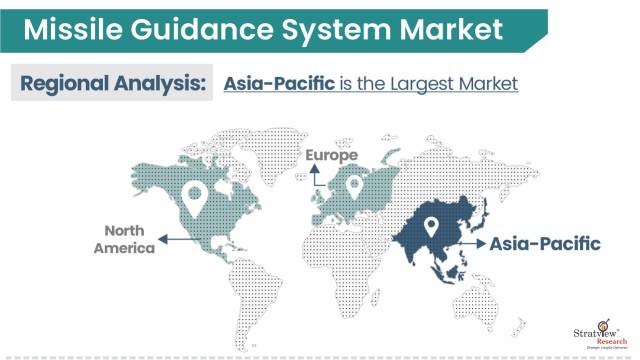
The market is split into North America, Europe, Asia Pacific, and LAMEA by geographic region. China dominates the Asian market thanks to significant military investment. The two most developed markets are the United States and China, where frequent missile testing contributes to the enduring need for missile-guiding radar. Israel and India are both developing as young market nations with advanced military systems. The Brazilian Army has made significant investments in missile intelligence and plans to increase its defensive capabilities. The market demand for missile guidance radar systems tends to increase in the case of space agencies, with the U.S., Russia, Europe, China, and India leading the pack.
Know the high-growth countries in this report. Register Here
There is stiff competition in the missile guidance system market. The growth of the companies is directly dependent on the industry conditions and government support. These companies differentiate their missile guidance systems based on their quality and penetration in the target and emerging markets. Also, some major mergers and acquisitions in the industry recently have significantly influenced the competitive dynamics. For example:
The overall competitive landscape has been affected due to these mergers and acquisitions. The following are the major players in the missile guidance system market:
Note: The above list does not necessarily include all the top players in the market.
Are you the leading player in this market? We would love to include your name. Write to us at [email protected]
This strategic assessment report, from Stratview Research, provides a comprehensive analysis that reflects today’s missile guidance system market realities and future market possibilities for the forecast period of 2022 to 2028. After a continuous interest in our missile guidance system market report from the industry stakeholders, we have tried to further accentuate our research scope to the missile guidance system market to provide the most crystal-clear picture of the market. The report segments and analyses the market in the most detailed manner to provide a panoramic view of the market. The vital data/information provided in the report can play a crucial role for the market participants as well as investors in the identification of the low-hanging fruits available in the market as well as to formulate the growth strategies to expedite their growth process.
This report offers high-quality insights and is the outcome of a detailed research methodology comprising extensive secondary research, rigorous primary interviews with industry stakeholders, and validation and triangulation with Stratview Research’s internal database and statistical tools. More than 1000 authenticated secondary sources, such as company annual reports, fact books, press releases, journals, investor presentations, white papers, patents, and articles, have been leveraged to gather the data. We conducted more than 15 detailed primary interviews with the market players across the value chain in all four regions and industry experts to obtain both qualitative and quantitative insights.
This report provides market intelligence in the most comprehensive way. The report structure has been kept such that it offers maximum business value. It provides critical insights into market dynamics and will enable strategic decision-making for existing market players as well as those willing to enter the market. The following are the key features of the report:
This report studies the market, covering a period of 12 years of trends and forecasts. The report provides detailed insights into the market dynamics to enable informed business decision-making and growth strategy formulation based on the opportunities present in the market.
The missile guidance system market is segmented into the following categories:
By Launch Platform Type
By Guidance System Type
By End-User Type
By Region
With this detailed report, Stratview Research offers one of the following free customization options to our respectable clients:
Company Profiling
Competitive Benchmarking
Custom Research: Stratview Research offers custom research services across sectors. In case of any custom research requirement related to market assessment, competitive benchmarking, sourcing and procurement, target screening, and others, please send your inquiry to [email protected].
The missile guidance system market was estimated at USD 451 million in 2021.
The missile guidance system market is likely to grow at a CAGR of 5.2% during 2022-2028.
The forecasted value of the missile guidance system market is expected to be USD 725 million in 2028.
The major players in the market are BAE Systems Plc, General Dynamics Corp., Leonardo Spa, Raytheon Technologies Corp., Safran SA, Lockheed Martin Corp., Luna Innovations Inc., Thales Group, The Boeing Co., DRDO.
The market for missile guidance systems is characterized by governments’ efforts to improve their current national security systems, growth in the number of missile system pilot demonstrations, and innovation and the adoption of new technology.


WE ACCEPT