



404
+1-313-307-4176

Space Debris Monitoring Market Analysis | 2022-2028

Space Debris Monitoring Market Size, Share, Trend, Dynamics, Forecast, & Growth Analysis: 2022-2028
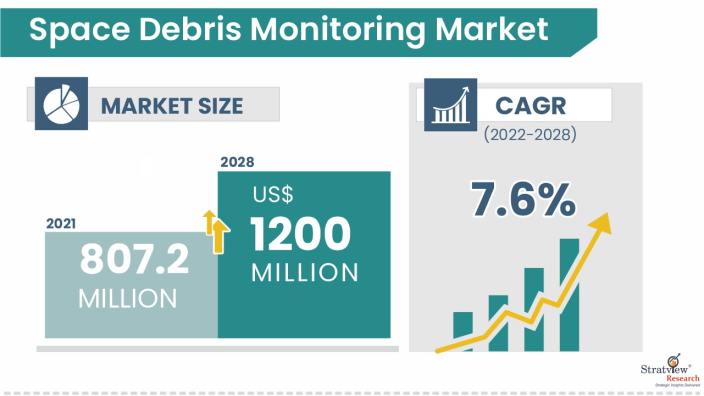
The space debris monitoring market was estimated at USD 807.2 million in 2021 and is likely to grow at a CAGR of 7.6% during 2022-2028 to reach USD 1200 million in 2028.
Want to know more about the market scope? Register Here
Space debris is any type of machinery or debris that is being left in space by humans that is not functional. The space debris could be as large as a rock or as small as a microscopic chip. These space debris include the spent rocket stages, dead or failed satellites, or some other man-made objects which has been left in orbit. The Department of Defence’s Global Space Surveillance Network (SSN) sensors have tracked more than 27,000 space debris. The spacecraft and debris travel at extremely high speeds of approximately 15,700 mph and the collision between these two could create massive destruction. The increasing population of space debris would create possible danger for all the space vehicles including the International Space Station and SpaceX’s Crew Dragon.
The space debris removal companies are responsible for controlling the increased population of debris in the space. Furthermore, the companies are more focused on the development of new product launches, patents, new technological innovations, and other strategies. Rising awareness about space pollution and an increasing number of satellites are some of the main factors that are likely to propel the growth of the global space debris monitoring market during the forecast period. The increasing number of space tourists has allowed scientists to meet the rising demand for space debris monitoring technology. Various companies have increased the budget for R&D departments to enable the use of the latest technologies such as coherent amplifying network lasers and super-wide-field-of-view telescopes. These latest technologies will enable tracking down the space debris and further destroying them. Unlike in developing and low-income countries, the absence of essential infrastructure and high research and development cost is expected to hinder the global space debris monitoring market growth.
The COVID-19 pandemic has negatively affected the global space debris monitoring industry which has impacted the ongoing space programs that were being carried out by the government organizations. The pandemic created lucrative opportunities for many mid-size and small private companies to invest in the market.
Several investments in the space debris monitoring industry have been directed at space debris in recent years, which would boost the overall market. Some of them are:
|
Segmentations |
List of Sub-Segments |
Dominant and Fastest-Growing Segments |
|
Orbit -Type Analysis |
Low Earth Orbit and Geostationary Orbit |
The Low Earth Orbit is expected to remain the biggest market for space debris monitoring market in the forecast period. |
|
Technology -Type Analysis |
Space Debris Removal and Space Debris Monitoring |
The space debris monitoring industry accounts for the largest market share in 2021. |
|
Debris Size Range -Type Analysis |
1mm to 1cm, 1cm to 10 cm, and Greater than 10 cm), By Orbit Type (Low Earth Orbit and Geostationary Orbit |
The 1mm to 1cm segment accounts for the highest share of the market in 2021. |
|
Regional Analysis |
North America, Europe, Asia-Pacific, and Rest of the World |
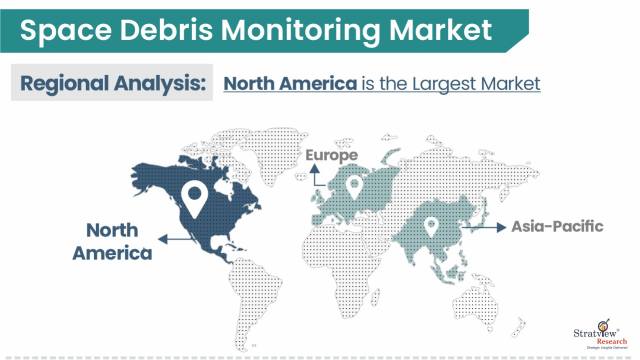
North America is likely to maintain its supremacy in the space debris monitoring market throughout the forecast period. |
The market is bifurcated into low earth orbit and geostationary orbit. The low earth orbit is expected to remain the biggest market for space debris monitoring during the forecast period. The orbit has an altitude of less than 1000 km but the orbit could even be as low as 160 km above the Earth’s surface. The increasing growth of this segment is primarily due to the increasing interest of scientists in launching communication satellites in the Low Earth Orbit region. SpaceX is further investing in providing internet services across the world in the coming years. This could be achieved by launching more than 1,400 satellites under the Starlink program. This initiative will further increase the population of space debris in LEO which would in turn propel the growth of the global space debris monitoring market.
The market is segmented into space debris removal and space debris monitoring. The space debris monitoring industry accounts for the largest market share in 2021, with the increasing demand for space debris modelling and space exploration activities.
The market is segmented as 1mm to 1cm, 1cm to 10 cm, and greater than 10 cm. The 1mm to 1cm segment accounts for the highest share in the market in 2021, due to the increasing number of rocket bodies as well as the removal of small objects from the satellite launch. The 1cm to 10cm segment is expected to register significant growth in the forecast years owing to the increase in space exploration activities. Approximately 200,000 pieces of space debris are in the range of 1cm to 10cm.
In terms of regions, North America is likely to maintain its supremacy in the space debris monitoring market throughout the forecast period. This is mostly due to the region's high number of space-based companies. Apart from this, the U.S. Department of Defence spends a huge amount on the monitoring of space debris to reduce the number of space debris in the next few years. Furthermore, the presence of various space organizations such as Northrop Grumman Corporation, Altius Space, and the Boeing Company is creating lucrative opportunities for the growth of the space debris monitoring market in the North American region.
Concurrently, Asia Pacific is expected to witness the fastest growth in the global space debris monitoring market during the forecast period. The key factors responsible for the swift growth are increased demand for space debris awareness from countries such as Japan, China, and India. Most of the Chinese-based firms are manufacturing their own optical sensor network known as the Asia-Pacific Optical Satellite Observation System (APOSOS) which has been further collaborated with the Asia-Pacific Space Cooperation Organization (APSCO).
Know the high-growth countries in this report. Register Here
There is huge competition in the space debris monitoring market. The growth of the companies is directly dependent on various factors such as government support and industry conditions. These companies differentiate their space debris monitoring technologies based on their new product development and penetration in emerging markets. Also, some key developments in the industry recently have significantly influenced the competitive dynamics. For example:
The overall competitive landscape has been affected due to mergers and acquisitions. The following are the major players in the space debris monitoring market:
This strategic assessment report, from Stratview Research, provides a comprehensive analysis that reflects today’s space debris monitoring market realities and future market possibilities for the forecast period of 2022 to 2028. After a continuous interest in our space debris monitoring market report from the industry stakeholders, we have tried to further accentuate our research scope to the space debris monitoring market to provide the most crystal-clear picture of the market. The report segments and analyses the market in the most detailed manner to provide a panoramic view of the market. The vital data/information provided in the report can play a crucial role for the market participants as well as investors in the identification of the low-hanging fruits available in the market as well as to formulate the growth strategies to expedite their growth process.
This report offers high-quality insights and is the outcome of a detailed research methodology comprising extensive secondary research, rigorous primary interviews with industry stakeholders, and validation and triangulation with Stratview Research’s internal database and statistical tools. More than 1000 authenticated secondary sources, such as company annual reports, fact books, press releases, journals, investor presentations, white papers, patents, and articles, have been leveraged to gather the data. We conducted more than 15 detailed primary interviews with the market players across the value chain in all four regions and industry experts to obtain both qualitative and quantitative insights.
This report provides market intelligence in the most comprehensive way. The report structure has been kept such that it offers maximum business value. It provides critical insights into market dynamics and will enable strategic decision-making for existing market players as well as those willing to enter the market. The following are the key features of the report:
This report studies the market, covering a period of 12 years of trends and forecasts. The report provides detailed insights into the market dynamics to enable informed business decision-making and growth strategy formulation based on the opportunities present in the market.
The space debris monitoring market is segmented into the following categories:
By Technology Type
By Application Type
By Debris Size Range Type
By Orbit Type
By Region
With this detailed report, Stratview Research offers one of the following free customization options to our respectable clients:
Company Profiling
Competitive Benchmarking
Custom Research: Stratview Research offers custom research services across the sectors. In case of any custom research requirement related to market assessment, competitive benchmarking, sourcing and procurement, target screening, and others, please send your inquiry to [email protected]
Space debris is any type of machinery or debris that is being left in space by humans that is not functional. The space debris could be as large as a rock or as small as a microscopic chip. These space debris include the spent rocket stages, dead or failed satellites, or some other man-made objects which has been left in orbit.
The space debris monitoring market was estimated at USD 807.2 million in 2021.
The forecasted value of the space debris monitoring market is expected to be USD 1200 million in 2028.
The space debris monitoring market is likely to grow at a CAGR of 7.6% during 2022-2028.
Rising awareness about space pollution and the increasing number of satellites are some of the main factors that are likely to propel the growth of the global market during the forecast period.
The major players in the market are Airbus SE, Raytheon Technologies Corporation, Astroscale Holdings Inc., D-Orbit SpA, and Northrop Grumman Corporation.
North America is likely to maintain its supremacy in the market throughout the forecast period.
The low earth orbit is expected to remain the biggest market for space debris monitoring during the forecast period.


WE ACCEPT