




404
+1-313-307-4176

Cured-in-Place Pipe Market Anlaysis | 2026-2032

Cured-in-Place Pipe (CIPP) Market Size, Share, Trend, Forecast, Competitive Landscape & Growth Opportunities: 2026-2032
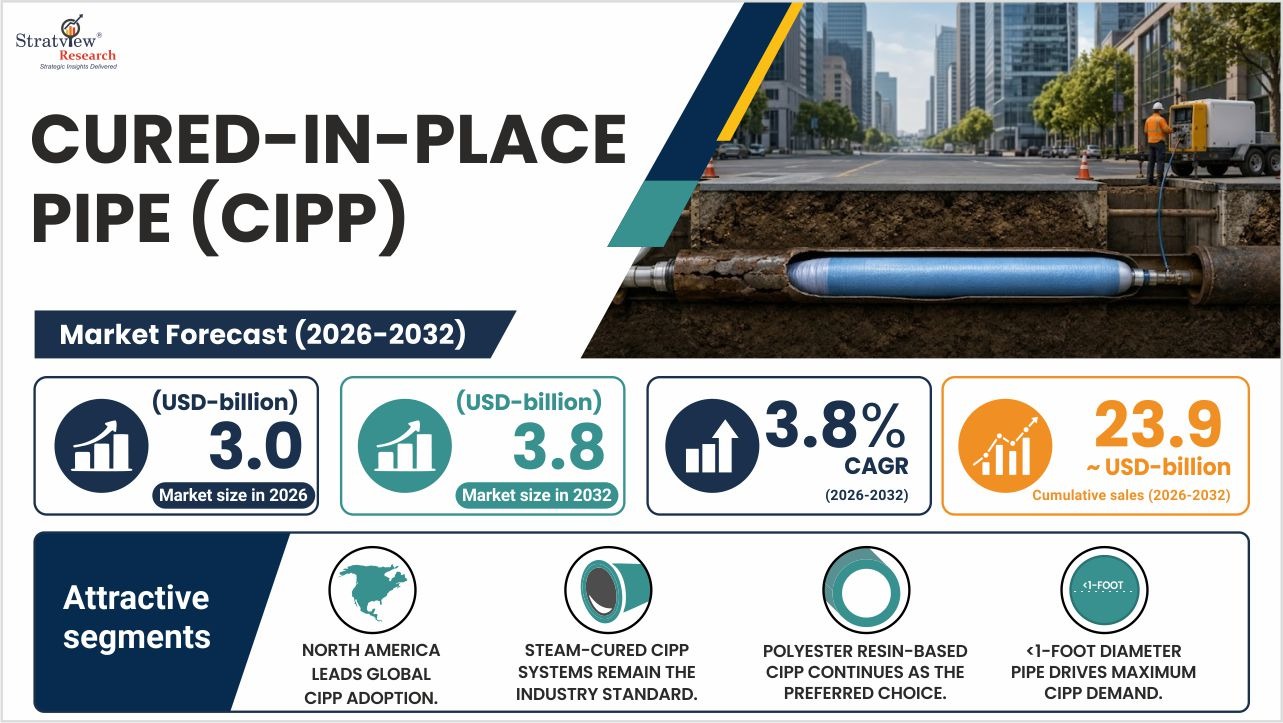
“The cured-in-place pipe (CIPP) market size will reach USD 3.0 billion in 2026 and offers robust growth opportunities for the market stakeholders. With the market expected to grow at a CAGR of 3.8%, the annual sales will hit USD 3.8 billion mark in 2032, reflecting the industry's shift toward trenchless pipe rehabilitation methods that reduce environmental impact, minimize excavation, and significantly shorten project timelines and infrastructure downtime.”
The annual demand for cured-in-place pipe (CIPP) was USD 2.9 billion in 2025 and is expected to reach USD 3.0 billion in 2026.
During the forecast period (2026-2032), the market is expected to grow at a CAGR of 3.8%. The annual demand will reach USD 3.8 billion in 2032.
North America generated the greatest demand across regions in the cured-in-place pipe (CIPP) market.
By diameter type, <1-foot diameter pipe is expected to maintain the lead in the market.
In terms of fabric type, polyester fabric-based CIPP is likely to remain the dominant segment throughout the forecast period.
PP-coated CIPP is likely to remain the most dominant coating type in the market.
Based on curing type, steam-cured CIPP continues to rule the market, owing to its shorter curing time and stronger finished products.
Among the resins, polyester resin-based CIPP is likely to remain the most preferred type in the market during the forecast period.
“According to a senior analyst at Stratview Research, the global cured-in-place pipe (CIPP) market will generate a cumulative sales opportunity worth USD 24.0 billion during 2026-2032. During the next six years, Polyester resin-based CIPP, <1-foot diameter Pipe, PP-coated CIPP, & North America are some of the high-opportunity segments to bank upon.”
Sharpen Your Strategies to Explore this USD 20+ billion Opportunity. Get Free Sample of Our Report: “Here”.
Have a look at the sales opportunities presented by the cured-in-place pipe (CIPP) market in terms of growth and market forecast.
|
Market Statistics |
Value (in USD Billion) |
Market Growth (%) |
|
Market Size in 2025 |
USD 2.9 billion |
- |
|
Market Size in 2026 |
USD 3.0 billion |
YoY Growth in 2026: 3.7% |
|
Market Size in 2032 |
USD 3.8 billion |
CAGR 2026-2032: 3.8% |
|
Cumulative Sales Opportunity during 2026-2032 |
USD 23.9 billion |
- |
|
Top 10 Countries’ Market Share in 2025 |
USD 2.6 billion + |
> 90% |
|
Top 10 Company’s Market Share in 2025 |
USD 1.7 billion to USD 2.0 billion |
60% - 70% |
Want to Explore the Market Opportunities? Get a free sample “Here”.
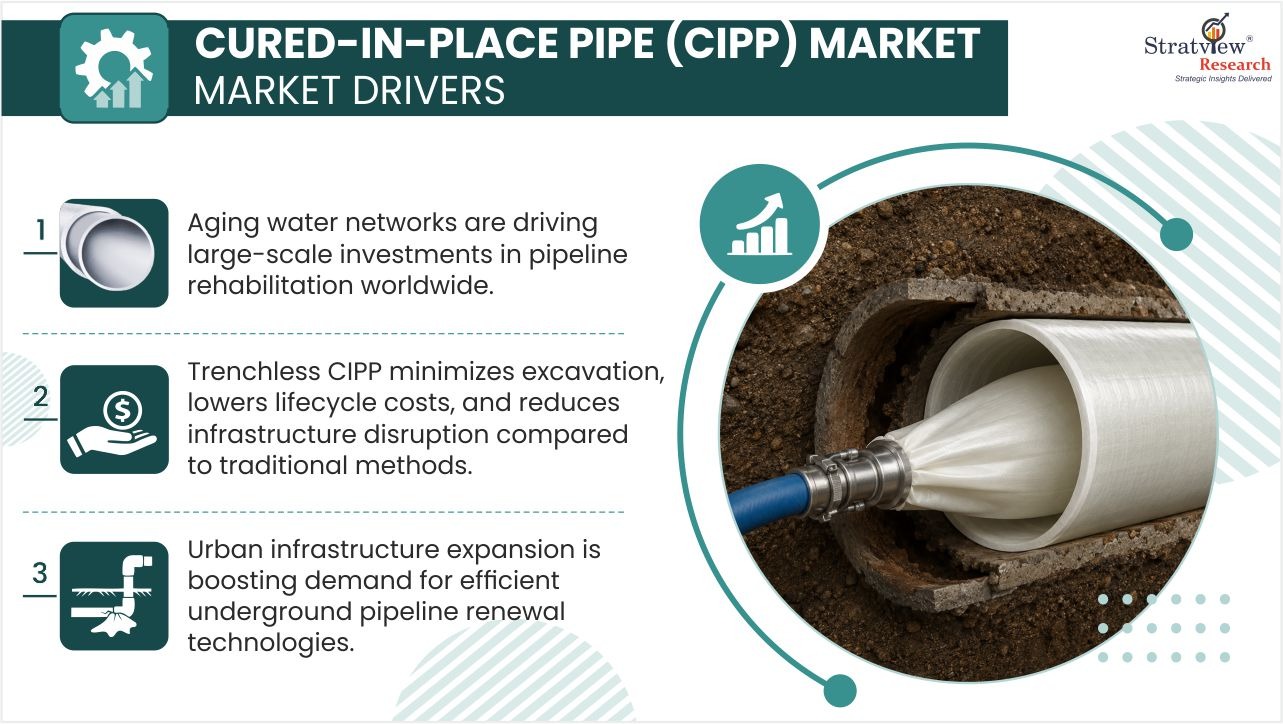
Cured-in-place pipe market is witnessing a decent growth trajectory, driven by the increasing need to rehabilitate aging water, wastewater, and industrial pipeline infrastructure through cost-effective solutions. Growing investments in infrastructure renewal and the need to reduce service disruptions are encouraging municipal authorities and infrastructure owners to adopt CIPP technology as an alternative to conventional pipe replacement.
Aging and Deteriorating Water Infrastructure Driving Demand for CIPP Solutions
Aging and deteriorating water infrastructure across the globe is creating an urgent need for efficient and cost-effective pipeline rehabilitation solutions, which is significantly driving the demand for Cured-in-Place Pipe (CIPP) technology. A major indicator of this challenge is the growing scale of water losses caused by pipeline failures and leaks.
Globally, around 35% of treated drinking water is lost every year due to leaks and system inefficiencies. In the United States alone, more than 240,000 water main breaks occur annually, resulting in economic losses of approximately US$ 2.6 billion and the wastage of trillions of gallons of treated drinking water.
To mitigate these losses and maintain service reliability, infrastructure rehabilitation is becoming a priority for utilities and municipalities. According to the US EPA, nearly 4,000 miles of pipelines currently require rehabilitation each year, and as water infrastructure continues to age, this requirement could increase to as much as 20,000 miles annually by 2035. CIPP has emerged as one of the most effective trenchless rehabilitation technologies because it enables utilities to restore existing pipelines with minimal excavation while extending pipeline service life by more than 30 years, making it an attractive long-term infrastructure investment.
Advantages Over Traditional Pipe Replacement Methods
Conventional open-cut pipe replacement often involves extensive excavation, road closures, utility disruptions, and lengthy construction schedules, making pipeline rehabilitation both expensive and time-consuming. In many projects, more than 70% of the total construction cost is associated with surface restoration, including roads, sidewalks, landscaping, and other public infrastructure, rather than the pipeline installation itself.
Cured-in-Place Pipe (CIPP) offers a more efficient alternative by rehabilitating pipelines internally with minimal excavation, significantly reducing project costs, labor requirements, traffic disruption, and construction timelines. The technology also delivers measurable environmental benefits. A 2025 study by the University of Texas at Arlington comparing CIPP with conventional open-cut replacement reported 56% lower overall environmental impact, 71% lower global warming potential, 72% lower fossil fuel depletion, and 67% lower smog formation.
In addition, CIPP installation can be completed up to five times faster than full pipe replacement while extending pipeline service life by more than 30 years. These economic, operational, and sustainability advantages are accelerating the adoption of CIPP as a preferred solution for municipalities and utility operators seeking cost-effective, low-impact pipeline rehabilitation.
Rapid Urbanization and Growing Infrastructure Development
Rapid urbanization and the expansion of underground utility infrastructure are creating substantial demand for CIPP-based pipeline rehabilitation solutions. As cities grow, the need for reliable water supply, wastewater management, and underground utility networks continues to rise.
According to the United Nations, the global urban population is expected to increase from 56% in 2020 to nearly 68% by 2050, with regions such as North America, Latin America, the Caribbean, Europe, and Oceania already highly urbanized. This rapid urban expansion is increasing pressure on aging pipeline systems, accelerating the adoption of trenchless technologies like CIPP to efficiently rehabilitate underground infrastructure while minimizing disruption in densely populated urban environments.
Shift Toward UV-Cured CIPP Systems
The growing adoption of UV-cured CIPP technology is creating significant growth opportunities in the CIPP market. Compared with traditional steam or hot-water curing methods, UV-cured CIPP systems enable faster installation, improved curing control, and reduced environmental impact.
These advantages are encouraging municipalities and contractors to increasingly adopt UV-cured trenchless pipe rehabilitation solutions, particularly for large-diameter sewer and wastewater pipelines.
“As per our analyst, the global cured-in-place pipe (CIPP) industry is evolving fast. While conducting the market analysis, and speaking with the leading players, it is quite clear that the next decade will be defined by the trends like advanced UV-cured CIPP systems, sustainable liner materials, and digital pipeline inspection for smarter asset management.”
Align with the Mega Trends Shaping the Industry. Get Free Sample “Here”.
Limited Awareness Regarding CIPP Technology in Developing Regions
In many developing regions, municipal authorities and other private infrastructure owners continue to rely on conventional excavation methods due to limited awareness of CIPP technology and its long-term lifecycle benefits. This lack of familiarity can slow market penetration despite increasing infrastructure rehabilitation needs.
Get Insights on High-Growth Segments. Get Free Sample “Here”.
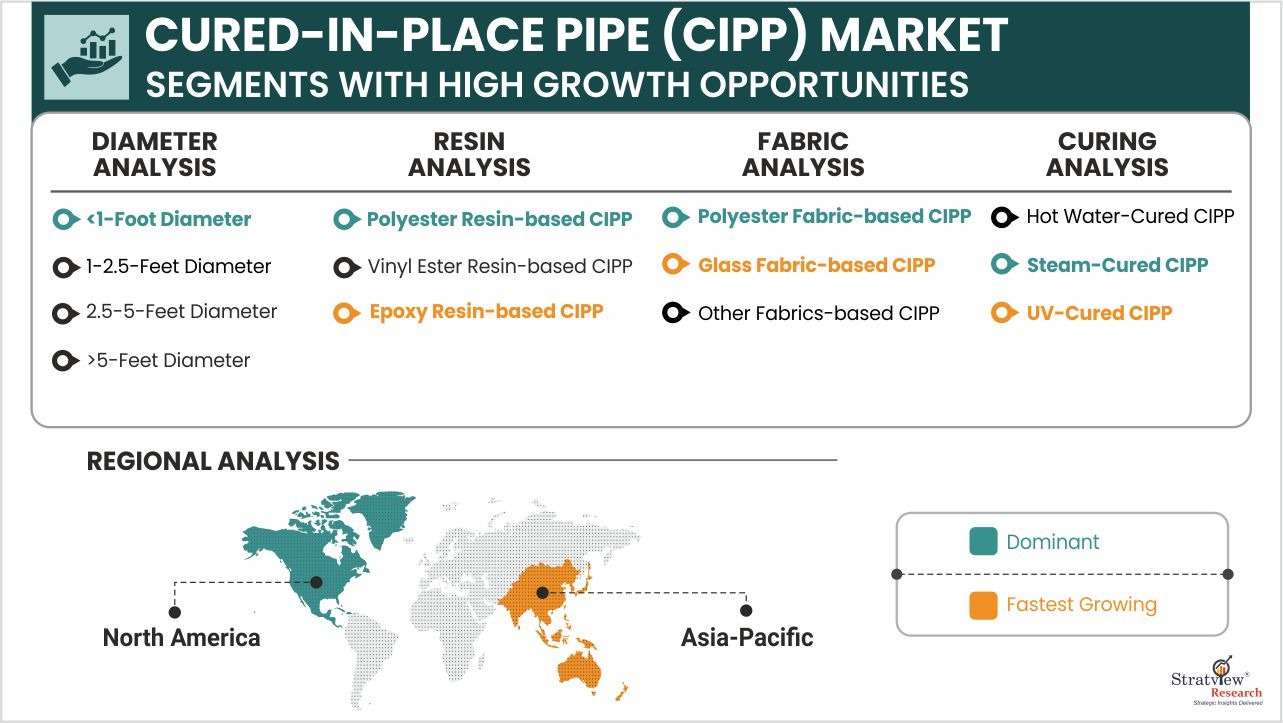
“<1-foot diameter pipe is likely to remain the largest and fastest-growing segment in the market during the forecast period.”
The CIPP market is segmented by pipe diameter into <1 foot, 1–2.5 feet, 2.5–5.0 feet, and >5.0 feet, with <1-foot diameter pipes expected to remain both the largest and fastest-growing segment during the forecast period.
This dominance is primarily driven by the extensive installed base of small-diameter pipelines used in sewer and potable water systems across regions. Standard sizes such as 8-inch pipes are among the most widely deployed globally, further reinforcing the high demand for rehabilitation solutions in this category.
“Polyester resin-based CIPP is expected to remain the dominant, whereas epoxy resin-based CIPP is expected to be the fastest-growing segment in the foreseeable future.”
Based on resin type, the market is categorized into polyester, vinyl ester, and epoxy resin-based CIPP, with polyester resin-based CIPP expected to maintain its leading position, whereas epoxy resin-based CIPP is anticipated to witness the fastest growth in the market throughout the forecast period. Polyester resins are widely used in sewer and stormwater applications due to their favorable mechanical properties, chemical resistance, and cost advantage over alternatives.
In contrast, epoxy resins are gaining traction as an environmentally friendly option with lower VOC emissions and no hazardous air pollutants (HAPs), making them particularly suitable for potable water applications where compliance with NSF/ANSI 61 standards is required.
“Polyester fabric-based CIPP is likely to remain the most preferred segment, whereas glass fabric-based CIPP is expected to be the fastest-growing segment in the market during the forecast period”
The market is segmented into polyester fabric-based CIPP, glass fabric-based CIPP, and other fabrics-based CIPP, with polyester fabric-based CIPP expected to remain the preferred choice, whereas glass fabric-based CIPP is projected to grow at the fastest rate in the coming years. Polyester fabric is widely adopted due to its ability to meet the required tensile strength standards, cost efficiency, and superior resin absorption characteristics.
Meanwhile, glass fabric is increasingly favored in UV curing applications, as it supports cleaner curing processes by avoiding the environmentally harmful by-products typically associated with steam- or water-cured felt liners.
“Steam-cured CIPP continues to rule the market with the largest share among all curing types. UV-cured CIPP is anticipated to mark the highest growth in the forecast period.”
Based on curing type, the market includes hot water-cured CIPP, steam-cured CIPP, and UV-cured CIPP methods, with steam-cured CIPP continuing to dominate the market, while UV-cured CIPP is expected to register the highest growth in the forecast period. Steam curing is preferred due to its faster heat transfer, reduced curing time, and ability to produce stronger finished liners compared to hot water curing, along with simpler and quicker setup requirements.
On the other hand, UV curing is gaining momentum due to its operational efficiency, such as no refrigeration needs, faster installation, and higher strength (3–5 times stronger than conventional felt liners), as well as its environmental benefits, including lower emissions and reduced sensitivity to temperature variations.
“North America is expected to remain the largest market for CIPP during the forecast period, whereas Asia-Pacific is likely to grow fastest.”
Regionally, North America is projected to remain the largest market for CIPP, driven by the USA, which leads both regionally and globally due to its extensive aging pipeline infrastructure, much of which was constructed post-World War II and now requires rehabilitation.
Meanwhile, Asia-Pacific is expected to witness the fastest growth, supported by increasing adoption of trenchless technologies in a region where current penetration remains relatively low. Rapid urbanization, infrastructure development, and growing awareness of efficient pipeline rehabilitation methods are accelerating market expansion across key countries in the region.
“Analysis suggests that the Top 10 countries generate >90% of the annual sales for the cured-in-place pipe (CIPP). A few countries are the demand powerhouses and will drive the regional markets in big ways offering attractive business opportunities.”
Speak to Us for Deep Diving into a Country/Region Specific Opportunity. Contact Us “Here”.
The market is fragmented with the presence of less than 100 global and regional players. Leading players hold excellent market positions with a vast product portfolio, a wide distribution network, and years of track record.
The following are the key players in the cured-in-place pipe (CIPP) market.
Per Aarsleff A/S
Waterline Renewable Technologies, Inc.
SAK Construction
SAERTEX Multicom® GmbH
RELINE UV Group
Vortex Companies
Note: The above list does not necessarily include all the top players in the market.
Are you a leading player in this market? We would love to include your name. Please write to us at [email protected]
Have the Competitive Edge with Our Intelligence. Get Free Sample “Here”.
In April 2026, United Felts acquired BKP Berolina Polyester GmbH & Co. KG, a Germany-based leader in advanced composite and UV-cured CIPP liner technology. The acquisition significantly expanded United Felts' global manufacturing footprint and strengthened its position in both traditional felt CIPP liners and advanced UV-CIPP systems.
In February 2026, Azuria Water Solutions acquired Waterline Renewal Technologies, adding brands such as Perma-Liner Industries, LMK Technologies, and LightRay to its trenchless rehabilitation portfolio. The acquisition expands Azuria’s CIPP and UV-cured lining capabilities for municipal and residential applications, supporting cured-in-place pipe market growth amid rising wastewater infrastructure rehabilitation demand.
In February 2026, Per Aarsleff Holding A/S acquired a 49.5% stake in LiquiForce Services (Ontario) Inc., a PURIS company, establishing a strategic partnership to strengthen its presence in the Canadian trenchless rehabilitation market. The transaction enhances both companies' capabilities in CIPP-based sewer and lateral rehabilitation solutions while accelerating the adoption of advanced rehabilitation technologies.
In June 2025, Azuria Water Solutions acquired Guildner Pipeline Maintenance to strengthen its underground infrastructure rehabilitation operations in North America. The acquisition expands the company’s trenchless pipeline service footprint, contributing to cured-in-place pipe market demand driven by aging sewer and stormwater infrastructure upgrades.
In April 2025, Azuria Water Solutions acquired Am-Liner East, a provider of cured-in-place pipe rehabilitation solutions. The acquisition strengthens Azuria’s regional rehabilitation capabilities and expands access to municipal sewer rehabilitation projects, supporting cured-in-place pipe market size expansion in the U.S. infrastructure sector.
In January 2024, Vortex Companies formed United Felts through the acquisition and integration of United Felts Inc., FerraTex Solutions, and MaxLiner®, creating a vertically integrated CIPP liner manufacturing platform serving the North American trenchless rehabilitation market. The move strengthened Vortex's position across the CIPP value chain, from raw materials to finished liner systems.
In June 2023, Azuria Water Solutions acquired AM-Liner East, Inc., a provider of cured-in-place pipe (CIPP) installation and trenchless rehabilitation services. The acquisition expanded Azuria's CIPP installation capabilities and strengthened its position in municipal wastewater rehabilitation projects across the eastern United States.
In October 2023, Azuria Water Solutions acquired C.K. Masonry Company, Inc., enhancing its wastewater infrastructure rehabilitation platform and broadening its service offering in underground infrastructure renewal, including CIPP-related rehabilitation projects.
In June 2025, LMK Technologies introduced a new steam-cured CIPP system for stormwater pipelines. The solution improves rehabilitation speed and reduces service disruption, supporting cured-in-place pipe market growth in urban drainage infrastructure projects.
CIPP (Cured-in-Place Pipe) is a trenchless pipe rehabilitation technology used to repair damaged pipelines without excavation. It is a non-invasive, jointless, seamless, pipe-within-a-pipe, which is used for the rehabilitation of sewer pipes, industrial gas pipes, potable water pipes, and gravity pipes. It can be performed inside a pipe with a diameter range of 6" to 120". This trenchless pipe rehabilitation method causes minimal disruption to traffic, work productivity, and people at home. Municipalities or utilities install it by accessing piping systems from city manholes. CIPP liner manufacturing has to be compliant with various standards, regulated by ASTM and has to follow the emission norms of different regulatory bodies, such as OSHA regulation.
The CIPP technology was invented by Insituform Technologies, Inc. in 1971 with the first project in London, the UK. Since then, the market has been witnessing incessant growth in its penetration across the world. There is already a high penetration of CIPP technology in developed economies, especially the USA, Germany, and Japan. Currently, the penetration of CIPP technology is limited in developing economies, such as China and India; however, this study reveals that the adoption rate is briskly increasing in these markets in the wake of aging pipelines coupled with increased spending on infrastructure rehabilitation.
There are various trenchless technologies used for pipe rehabilitation, such as CIPP, SIPP, pipe bursting, and slip lining. Among all, CIPP is the most widely used technology and alone accounts for a mammoth share of the trenchless pipe rehabilitation market.
This report provides market intelligence most comprehensively. The report structure has been kept so that it offers maximum business value. It provides critical insights into market dynamics and will enable strategic decision-making for existing market players as well as those willing to enter the market.
The following are the key features of the report:
Market structure: Overview, industry life cycle analysis, supply chain analysis.
Market environment analysis: Growth drivers and constraints, Porter’s five forces analysis, SWOT analysis.
Market trend and forecast analysis.
Market segment trend and forecast.
Competitive landscape and dynamics: Market share, Service portfolio, New Product Launches, etc.
Attractive market segments and associated growth opportunities.
Emerging trends.
Strategic growth opportunities for the existing and new players.
Key success factors.
|
Market Study Period |
2020-2032 |
|
Base Year |
2025 |
|
Forecast Period |
2026-2032 |
|
Trend Period |
2020-2025 |
|
Number of Tables & Figures |
>100 |
|
Number of Segments Analysed |
7 (Pipe Diameter Type, Resin Type, Fabric Type, Curing Type, Coating Type, Weaving Type, and Region) |
|
Number of Regions Analysed |
4 (North America, Europe, Asia-Pacific, Rest of the World) |
|
Countries Analysed |
15 (The USA, Canada, Mexico, Germany, France, Italy, The UK, China, Japan, India, Brazil, Saudi Arabia, Rest of Europe, Rest of APAC, and Rest of the World) |
|
Free Customization Offered |
10% |
|
After Sales Support |
Unlimited |
|
Report Presentation |
Complimentary |
|
Market Dataset |
Complimentary |
|
Further Deep Dive & Consulting Services |
10% Discount |
Want a Report Tailor-Made to Your Objectives? Speak with Our Analyst at [email protected]
The report provides detailed insights into the market dynamics to enable informed business decision-making and growth strategy formulation based on the opportunities present in the market.
The cured-in-place pipe (CIPP) market is segmented into the following categories:
Cured-in-Place Pipe (CIPP) Market, By Pipe Diameter Type
<1-Foot Diameter
1-2.5-Feet Diameter
2.5-5-Feet Diameter
>5-Feet Diameter
Cured-in-Place Pipe (CIPP) Market, By Resin Type
Polyester Resin-based CIPP
Vinyl Ester Resin-based CIPP
Epoxy Resin-based CIPP
Cured-in-Place Pipe (CIPP) Market, By Fabric Type
Polyester Fabric-based CIPP
Glass Fabric-based CIPP
Other Fabrics-based CIPP
Cured-in-Place Pipe (CIPP) Market, By Weaving Type
Woven CIPP
Non-woven CIPP
Other-weaved CIPP
Cured-in-Place Pipe (CIPP) Market, By Curing Type
Hot Water-Cured CIPP
Steam Cured-CIPP
UV-Cured CIPP
Cured-in-Place Pipe (CIPP) Market, By Coating Type
PP-Coated CIPP
PE-Coated CIPP
PU-Coated CIPP
Non-Coated CIPP
Other Coatings-based CIPP
Cured-in-Place Pipe (CIPP) Market, By Region
North America (Country Analysis: The USA, Canada, and Mexico)
Europe (Country Analysis: Germany, France, The UK, Spain, and the Rest of Europe)
Asia-Pacific (Country Analysis: China, Japan, Australia, Singapore, and Rest of Asia-Pacific)
Rest of the World (Sub-Region Analysis: Latin America, Middle East, and Others)
Looking for a Deep Dive? Speak with Our Analyst at [email protected]
This strategic assessment report from Stratview Research provides a comprehensive analysis that reflects today’s CIPP market realities and future market possibilities for the forecast period.
The report segments and analyzes the market in the most detailed manner to provide a panoramic view of the market.
The vital data/information provided in the report can play a crucial role for market participants and investors in identifying the low-hanging fruits available in the market and formulating growth strategies to expedite their growth process.
This report offers high-quality insights and is the outcome of a detailed research methodology comprising extensive secondary research, rigorous primary interviews with industry stakeholders, and validation and triangulation with Stratview Research’s internal database and statistical tools.
More than 1,000 authenticated secondary sources, such as company annual reports, fact books, press releases, journals, investor presentations, white papers, patents, and articles, have been leveraged to gather the data.
We conducted more than 15 detailed primary interviews with market players across the value chain in all four regions and industry experts to obtain both qualitative and quantitative insights.
With this detailed report, Stratview Research offers one of the following free customization options to our respected clients:
Company Profiling
Detailed profiling of additional market players (up to three players)
SWOT analysis of key players (up to three players)
Competitive Benchmarking
Benchmarking of key players on the following parameters: Service portfolio, geographical reach, regional presence, and strategic alliances
Custom Research: Stratview Research offers custom research services across sectors. In case of any custom research requirement related to market assessment, competitive benchmarking, sourcing and procurement, target screening, and others, please send your inquiry to [email protected]
The report is delivered digitally through our online portal. Buyers receive login credentials from our team to access the report and may update their credentials at any time after the initial login.
Delivery timelines depend on the status of the report:
For the most accurate delivery timeline, please contact us to confirm the current status of the report.
Yes. You may request a complimentary preview of the report through a video conference with our team.
Yes. The scope of the report can be fully customized to align with your specific research objectives and information requirements.
Please contact us at [email protected], and our team will be happy to discuss your requirements and propose a tailored solution.
Yes. Selected sections of the report can be purchased separately based on your requirements. Please contact us at [email protected] to discuss your needs.
Yes, AI can help gather publicly available information, but its outputs are only as reliable as the data it accesses. Stratview Research reports are built using validated data, extensive primary interviews with industry stakeholders, and the expertise of our experienced research team.
Additionally, many critical insights, including market dynamics, competitive intelligence, and industry-specific trends, are not publicly available and therefore cannot be captured through AI alone.
The cured-in-place pipe (CIPP) market size was USD 2.9 billion in 2025. The market is expected to grow from USD 3.0 billion in 2026 to USD 3.8 billion in 2032, witnessing a decent market growth (CAGR) of 3.8% during the forecast period (2026-2032).
The forecasted value of the market is USD 3.8 Billion in 2032.
The key players in the CIPP market are Aegion Corporation, PURIS Corporation, Per Aarsleff A/S, Reline UV Group, SAERTEX Multicom® GmbH, IMPREG Group, Ashimori Industry Co, Ltd., Michels Corporation, and Waterline Renewal Technologies.
North America remains the largest CIPP market, driven by extensive investments in aging water and wastewater infrastructure rehabilitation and widespread adoption of trenchless technologies. Meanwhile, Asia-Pacific is expected to witness the fastest growth, fueled by rapid urbanization, expanding municipal infrastructure, and increasing demand for trenchless pipeline rehabilitation.
Polyester resin-based CIPP is expected to maintain its supremacy throughout the forecast period. This is primarily because polyester resin is a low-cost product and it has several favorable attributes, such as high flexural modulus, low tensile elongation, and good chemical resistance.


WE ACCEPT