



404
+1-313-307-4176

IP Telephony Market Analysis | 2023-2028

IP Telephony Market Size, Share, Trends, Dynamics, Forecast, & Growth Analysis: 2023-2028
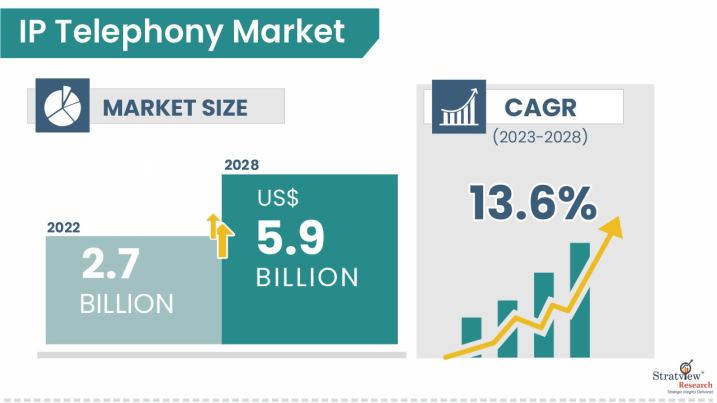
The IP telephony market was estimated at USD 2.7 billion in 2022 and is likely to grow at a CAGR of 13.6% during 2023-2028 to reach USD 5.9 billion in 2028.
Want to know more about the market scope? Register Here
IP Telephony, or Internet Protocol Telephony, refers to the technology that enables voice communication over the Internet using Internet Protocol (IP) networks. Unlike traditional telephone systems that rely on analog signals, IP Telephony converts voice into data packets and transmits them over IP networks, including the Internet. This technology allows for more efficient and cost-effective communication by utilizing existing network infrastructure.
IP Telephony offers features such as voice calling, video calling, voicemail, call forwarding, and conferencing, all accessible through IP-enabled devices like computers, smartphones, and IP phones. It provides businesses and individuals with flexible and scalable communication solutions, enabling seamless connectivity and collaboration across geographical locations.
The IP telephony market is driven by a host of factors, some of which are noted below:
Due to the low cost of IP telephony systems. IP telephony, or Voice over Internet Protocol (VoIP), allows businesses to make phone calls over the Internet rather than traditional phone lines. This technology has become increasingly popular due to its many benefits, including cost savings, flexibility, and scalability.
IP telephony can be a cost-effective solution for businesses looking to improve communication and collaboration, while also gaining flexibility and scalability.
The integration of IP telephony and IoT technologies can indeed bring significant benefits to organizations. By combining these two technologies, organizations can create a more streamlined and efficient communication system that can improve productivity, reduce costs, and enhance customer experiences.
During the COVID-19 pandemic, there has been an increase in the demand for mobile IP telephone apps to keep in touch with staff working remotely. IP video telephony enables employees to work from anywhere at any time by utilizing remote access technologies, thereby improving job quality and productivity. Furthermore, the increased flexibility of IP video telephony can provide employees with lifestyle benefits.
|
Segmentations |
List of Sub-Segments |
Segments with High Growth Opportunity |
|
Type Analysis |
Integrated Access/Session Initiation Protocol (SIP) Trunking, Managed IP PBX, Hosted IP PBX |
The Integrated Access/Session Initiation Protocol (SIP) Trunking dominated the market with a significant share of the market during the forecast period. |
|
Call Type Analysis |
International Calls, Domestic Calls |
The international calls segment held the largest share of the market during the forecast period & is expected to grow at a robust CAGR. |
|
Enterprise Type Analysis |
Large Enterprise, Small & Medium Enterprises |
The Small & Medium Enterprises segment occupied a significant share of the market during the forecast period. |
|
End-User Type Analysis |
Corporate, Government, Residential |
The corporate segment held a significant market share during the forecast period. |
|
Regional Analysis |
North America, Europe, Asia-Pacific, and Rest of the World |
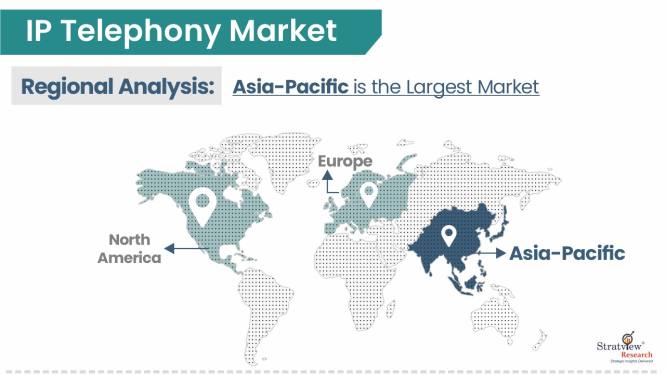
Asia-Pacific accounted for the largest market share and is expected to maintain its dominance during the forecast period. |
The IP telephony market has been classified into Integrated Access/Session Initiation Protocol (SIP) Trunking, Managed IP PBX & Hosted IP PBX. The Integrated Access/Session Initiation Protocol (SIP) Trunking dominated the market with a significant share of the market during the forecast period.
The integrated access/session initiation protocol (SIP) trunking sub-segment provides a secure, end-to-end encrypted communication system that is simple to manage. Furthermore, the call quality is superb, and there are no restrictions on the number of users, these features are projected to grow the sub-segment in the near future.
The market has been classified into International Calls & Domestic Calls. Under these, the international calls segment held the largest share of the market during the forecast period & is expected to grow at a robust CAGR. IP telephony offers numerous benefits for international calls, including lower call costs and superior call quality as compared to traditional calling services.
Furthermore, IP telephony provides a variety of other options, such as the ability to acquire a phone number from any country and use it for communication purposes; this way, calls are priced on a domestic call basis rather than an international call basis.
The Ip telephony market has been bifurcated into large enterprises, small & medium enterprises. The Small & Medium Enterprises segment occupied a significant share of the market during the forecast period. The enormous rise of the worldwide small and medium-business sector is the primary driver of IP telephony growth. Because they do not have a lot of money to spend on multiple subscriptions, expensive international calls, and other services, small and medium-sized enterprises prefer IP telephony.
The market has been classified into Corporate, Government, and Residential. Under these, the corporate segment held a significant market share during the forecast period. IP telephony has lower overall costs because it leverages existing data networks, eliminating the need for separate voice and data networks.
Additionally, it offers advanced features such as call routing, video conferencing, and voicemail-to-email transcription that can improve productivity and collaboration.
In terms of region, Asia-Pacific accounted for the largest market share and is expected to maintain its dominance during the forecast period. However, overall, there is a growing demand for IP telephony solutions and UC applications among businesses in the region, particularly in more advanced markets such as Japan, South Korea, Singapore, and Australia.
One key factor driving this trend in the region is the increasing need for businesses to improve their communication and collaboration capabilities, particularly in the context of remote work and global business operations. IP telephony solutions and UC applications offer a range of features and functionalities that can help businesses streamline their communication processes, enhance productivity, and reduce costs.
Know the high-growth countries in this report. Register Here
The following are the key players operating in the market:
Note: The above list does not necessarily include all the top players in the market.
Are you the leading player in this market? We would love to include your name. Write to us at [email protected]
This strategic assessment report, from Stratview Research, provides a comprehensive analysis that reflects today’s IP telephony market realities and future market possibilities for the forecast period of 2023 to 2028. After a continuous interest in our IP telephony market report from the industry stakeholders, we have tried to further accentuate our research scope to the IP telephony market to provide the most crystal-clear picture of the market. The report segments and analyses the market in the most detailed manner to provide a panoramic view of the market. The vital data/information provided in the report can play a crucial role for the market participants as well as investors in the identification of the low-hanging fruits available in the market as well as to formulate the growth strategies to expedite their growth process.
This report offers high-quality insights and is the outcome of a detailed research methodology comprising extensive secondary research, rigorous primary interviews with industry stakeholders, and validation and triangulation with Stratview Research’s internal database and statistical tools. More than 1000 authenticated secondary sources, such as company annual reports, fact books, press releases, journals, investor presentations, white papers, patents, and articles, have been leveraged to gather the data. We conducted more than 15 detailed primary interviews with the market players across the value chain in all four regions and industry experts to obtain both qualitative and quantitative insights.
This report provides market intelligence in the most comprehensive way. The report structure has been kept such that it offers maximum business value. It provides critical insights into market dynamics and will enable strategic decision-making for existing market players as well as those willing to enter the market. The following are the key features of the report:
This report studies the market, covering a period of 12 years of trends and forecasts. The report provides detailed insights into the market dynamics to enable informed business decision-making and growth strategy formulation based on the opportunities present in the market.
The IP telephony market is segmented into the following categories:
By Type
By Call Type
By Enterprise Type
By End-User Type
By Region
With this detailed report, Stratview Research offers one of the following free customization options to our respectable clients:
Company Profiling
Market Segmentation
Competitive Benchmarking
Custom Research: Stratview Research offers custom research services across sectors. In case of any custom research requirement related to market assessment, competitive benchmarking, sourcing and procurement, target screening, and others, please send your inquiry to [email protected].
IP Telephony, or Internet Protocol Telephony, refers to the technology that enables voice communication over the Internet using Internet Protocol (IP) networks. Unlike traditional telephone systems that rely on analog signals, IP Telephony converts voice into data packets and transmits them over IP networks, including the Internet. This technology allows for more efficient and cost-effective communication by utilizing existing network infrastructure. IP Telephony offers features such as voice calling, video calling, voicemail, call forwarding, and conferencing, all accessible through IP-enabled devices like computers, smartphones, and IP phones. It provides businesses and individuals with flexible and scalable communication solutions, enabling seamless connectivity and collaboration across geographical locations.
The IP telephony market was estimated at USD 2.7 billion in 2022.
The forecasted value of the IP telephony market is expected to be USD 5.9 billion in 2028.
The IP telephony market is likely to grow at a CAGR of 13.6% during 2023-2028.
Asia-Pacific accounted for the largest market share & is expected to maintain its dominance during the forecast period.
The target audience of the market includes IP Telephony companies, IP Telephony distributors, Corporate, Government, and Residential.
The key players operating in the market are Dialpad, Inc., Freshworks Inc., Intermedia.net, Inc., Microsoft, Mitel Networks Corp., Ooma, Inc., RingCentral MVP, Vonage, Ziff Davis, Inc., 8x8, Inc.
The Integrated Access/Session Initiation Protocol (SIP) Trunking dominated the market with a significant share of the market during the forecast period.


WE ACCEPT