


404
+1-313-307-4176

Space Power Supply Market Analysis | 2026-2031

Space Power Supply Size, Share, Trend, Forecast, Competitive Analysis, and Growth Opportunity: 2026-2031
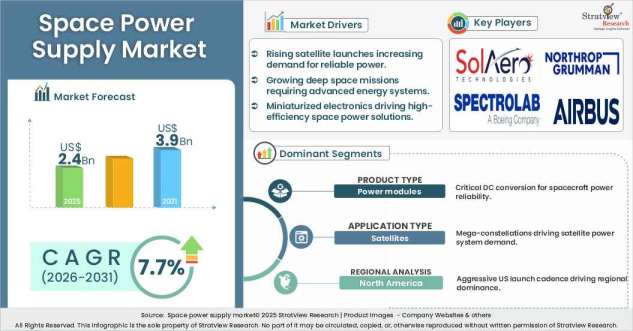
“The space power supply market size was USD 2.4 billion in 2025 and is likely to grow at a decent CAGR of 7.7% during 2026-2031 to reach USD 3.9 billion in 2031.”
Want to know more about the market scope? Register Here
The power supply system covers all aspects: generation, storage, conditioning, distribution, and conversion for space applications. Space missions can last from a few minutes to decades; therefore, finding the optimum primary and secondary sources with an architecture that will make the best use remains paramount.
The space industry, including space power supply, is highly regulated, where all parts require a rigorous quality check and legal documentation before their use in a spacecraft. Furthermore, the industry's demand for power supply products is largely impacted by new technological advancements, satellite launches, regulations (EWR 127-1, MIL-STD), etc. Major players have been hammering hard for the advancements in the existing products for meeting the changing market requirements.
The space power supply market includes solar cells, batteries, power modules, and generators. These technologies are being developed to meet the needs of long missions and deep-space exploration. Growing investments in low-Earth orbit constellations, defense applications, and space exploration programs are driving the need for high-efficiency, lightweight, and durable power technologies.
The space power supply market is expected to witness strong growth in the coming years, driven by the accelerating deployment of small satellites, the adoption of reusable launch systems, and the rising number of government and commercial space missions. Power supply system forms the backbone of spacecraft operations, enabling propulsion, communication, payload functionality, and thermal management. As mission complexity and duration increase, the demand for highly reliable and efficient power solutions has become mission-critical for both satellites and launch vehicles. Improvements in solar cell efficiency, battery energy density, and nuclear-based systems are also boosting adoption. Furthermore, the rising demand for long-duration missions, deep-space exploration, and sustainable satellite operations is increasing the need for innovative space power supply technologies.
|
Segmentations |
List of Sub-Segments |
Segments with High-Growth Opportunity |
|
Product-Type Analysis |
Solar Panels & Arrays, Batteries (Primary Batteries, Secondary Batteries, and Reserve Batteries), Power Modules, Thermoelectric Generators, and Other Products) |
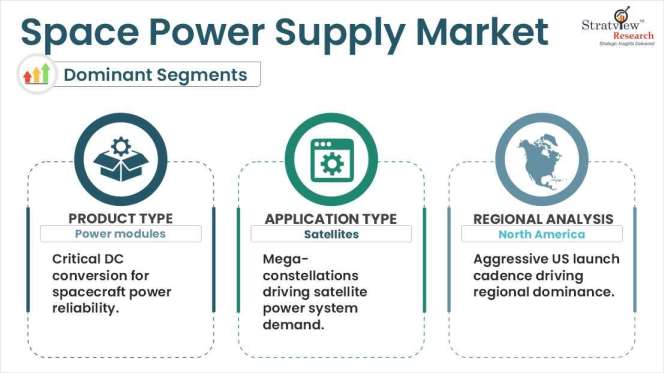
Power modules are expected to remain dominant in the market in the coming years. Among battery types, secondary batteries are likely to remain dominant in the coming years. |
|
Application-Type Analysis |
Launch Vehicles (Small & Medium-Lift and Heavy & Super-Heavy Lift), Satellites (LEO, MEO, and GEO), and Space Exploration (Rovers and Other Space Explorations) |
Satellites will continue to dominate the application segment, while launch vehicles are expected to be the fastest-growing segment in the coming years. Small & Medium launch vehicles and LEO satellites are expected to remain dominant in the coming years. |
|
Region Analysis |
North America, Europe, Asia-Pacific, and Rest of the World |
North America is expected to maintain its reign over the forecast period. |
“Power modules are expected to remain the most prevalent segment in the near future.”
The space power supply market is segmented as solar panels & arrays, batteries, power modules, thermoelectric generators, and other products based on the product type. Power modules dominated the market with DC converter modules being one of the key components. The battery segment is further classified into battery types as primary, secondary, and reserve batteries as well as into material type as nickel, lithium, silver-zinc, and others. Lithium-ion batteries are likely to remain the dominant material type, while silver-zinc batteries are expected to be the fastest-growing in the coming years.
Thermoelectric generators are estimated to remain the second-largest segment of the market till 2031. Radioisotope thermoelectric generators (RTGs), which use nuclear decay of radioactive isotopes, are used to power space vehicles. They have low-power conversion efficiency but provide higher specific energy than any battery or fuel cell.
“Satellites are expected to maintain their dominance over the forecast period, while launch vehicles are projected to be the fastest-growing segment.”
In terms of application type the space power supply market is segmented as launch vehicles, satellites, and space exploration.
As per Bryce Tech 2025 report, nearly 2,800 smallsats were launched in 2024, accounting for 97% of all spacecraft launched and 81% of total spacecraft upmass. This sustained launch activity, largely driven by mega-constellations such as Starlink and OneWeb, is significantly boosting demand for solar arrays, lightweight and baseline batteries, and advanced power modules.
Satellites in LEO remain the primary growth engine, supporting key applications including communications, Earth observation, and navigation, while Geostationary Orbit (GEO) Satellites continue to generate stable demand for commercial communications. As satellite operators increasingly focus on cost optimization and extended mission lifetimes, satellites are expected to account for the largest share of space power supply demand throughout the forecast period.
Launch vehicles are expected to be the fastest-growing segment of the market in the coming years. Declining launch service costs, improving technological capabilities, and the increasing adoption of reusable rocket systems are the key factors driving growth in this segment.
“North America is expected to remain the largest region for the space power supply market during the forecast period.”
In terms of regions, North America is likely to maintain its huge dominance in the market in the foreseeable future. The USA held a huge dominance, alone capturing more than two-thirds share of the total market. The region is likely to offer the highest growth opportunities during the forecast period as well, with increasing investments of start-ups and aggressive launch activities by SpaceX. Asia-Pacific is to remain the second-largest region of the market during the forecast period. The region’s space budget is almost half of North America’s space budget. China and India are other key countries, have a conspicuous share in the global market. The Asia-Pacific region is expected to be the fastest-growing region, driven by ambitious programs in China, India, and Japan.
Know the high-growth countries in this report. Register Here
The market is moderately concentrated, with the presence of a handful number of players from small-to-big global and regional players active in market. There is a dominance of different players in different product segments, such as Solaero Technologies, Spectrolab, and Northrup Grumman are the leading players in the solar panels & arrays segment. Saft Groupe SA, GS Yuasa Corporation, and EaglePicher Technologies are the leading players in the battery segment. The following are the key players in the space power supply market:
Here is the list of the Top Players (Based on Dominance)
Note: The above list does not necessarily include all the top players in the market.
Are you the leading player in this market? We would love to include your name. Please write to us at [email protected]
This report provides market intelligence most comprehensively. The report structure has been kept so that it offers maximum business value. It provides critical insights into market dynamics and will enable strategic decision-making for existing market players as well as those willing to enter the market. The following are the key features of the report:
This report studies the market, covering a period of 12 years of trends and forecasts. The report provides detailed insights into the market dynamics to enable informed business decision-making and growth strategy formulation based on the opportunities present in the market.
The space power supply market is segmented into the following categories.
Space Power Supply Market, by Product Type
Space Power Supply Market, by Application Type
Space Power Supply Market, by Region
With this detailed report, Stratview Research offers one of the following free customization options to our respectable clients:
Company Profiling
Competitive Benchmarking
Custom Research: Stratview Research offers custom research services across sectors. In case of any custom research requirement related to market assessment, competitive benchmarking, sourcing and procurement, target screening, and others, please send your inquiry to [email protected].
Space power supply refers to systems like solar arrays, batteries, power modules, and thermoelectric generators that provide energy for satellites, launch vehicles, and space exploration missions.
The space power supply market is estimated to reach US$3.9 billion by 2031.
The space power supply market is estimated to grow at a CAGR of 7.7% by 2031. Key factors driving the market are accelerating deployment of small satellites, the adoption of reusable launch systems, and the rising number of government and commercial space missions. Power supply system forms the backbone of spacecraft operations, enabling propulsion, communication, payload functionality, and thermal management.
North America is expected to remain dominant in the space power supply market during the forecast period. Strong space budget of NASA and increasing investment in space start-ups were key factors behind the exceptional growth in the demand for power supply systems in the North American space industry.
SolAero Technologies, Inc., Northrop Grumman Corporation, Spectrolab, Airbus, Sierra Nevada Corporation, Saft Groupe SA, EaglePicher Technologies, AZUR Space Solar Power GmbH, Teledyne Technologies, Aerojet Rocketdyne, and Airborne are the top players in the market.


WE ACCEPT