


404
+1-313-307-4176

Sports Nutrition Market Analysis| 2026-2034

Sports Nutrition Market Size, Share, Trend, Forecast, Competitive Landscape & Growth Opportunities: 2026-2034
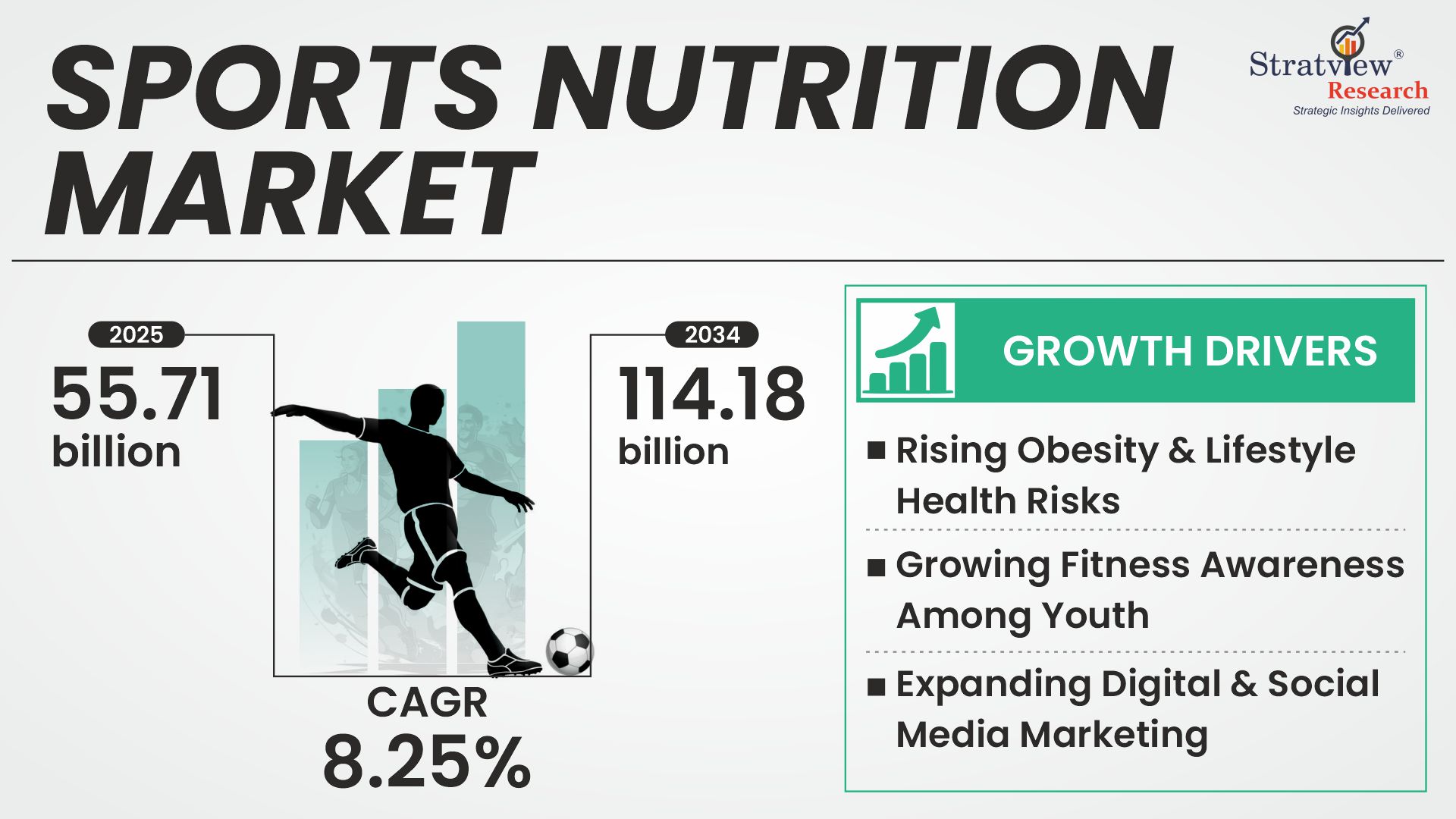
The annual demand for sports nutrition was USD 55.71 billion in 2025 and is expected to reach USD 60.56 billion in 2026, up 8.70% than the value in 2025.
During the forecast period (2026-2034), the sports nutrition market is expected to grow at a CAGR of 8.25%. The annual demand will reach USD 114.18 billion in 2034, which is almost 2 times the demand in 2026.
During 2026-2034, the sports nutrition industry is expected to generate a cumulative sales opportunity of USD 767.41 billion.
North America is estimated to generate the highest demand in the market.
By product type, sports supplement segment holds the largest share of the sports nutrition market.
By distribution channel type, online stores are expected to expand with the fastest CAGR during the forecast period.
Have a look at the sales opportunities presented by the sports nutrition market in terms of growth and market forecast.
|
Sports Nutrition Market Data & Statistics |
|
||
|
Market Statistics |
Value (in USD Billion) |
Market Growth (%) |
|
|
Annual Market Size in 2024 |
USD 51.20 billion |
- |
|
|
Annual Market Size in 2025 |
USD 55.71billion |
YoY Growth in 2025: 8.80% |
|
|
Annual Market Size in 2026 |
USD 60.56 billion |
YoY Growth in 2026: 8.70% |
|
|
Annual Market Size in 2034 |
USD 97.98 billion |
CAGR 2026-2034: 8.25% |
|
|
Cumulative Sales Opportunity during 2026-2034 |
USD 767.41 billion |
- |
|
|
Top 10 Countries’ Market Share in 2025 |
USD 44.56 billion + |
> 80% |
|
|
Top 10 Companies’ Market Share in 2025 |
USD 27.85 billion to USD 39.00 billion |
50% - 70 |
|
Sports nutrition refers to the use of specially formulated food products and dietary supplements that support physical performance, muscle development, endurance, recovery, and overall fitness. These products are designed for athletes, gym users, sportspersons, fitness enthusiasts, and individuals who follow an active lifestyle.
The category includes protein powders, amino acid supplements, energy and hydration drinks, nutrition bars, meal replacement shakes, and functional nutrition products. Over time, sports nutrition has moved beyond professional sports and is now widely used by recreational athletes, home workout users, and wellness-focused consumers.
Rising Obesity and Lifestyle-Related Health Issues
According to the World Obesity Federation’s 2025 Atlas, the number of adults living with obesity is projected to increase by over 115% between 2010 and 2030, rising from 524 million to approximately 1.13 billion. Sedentary work patterns, reduced physical activity, and increased consumption of processed foods have significantly contributed to this global health challenge.
These developments have heightened public awareness about physical fitness, weight management, and balanced nutrition. As a result, consumers are increasingly adopting protein supplements, meal replacements, and functional nutrition products to support healthier lifestyles, directly accelerating demand in the global sports nutrition market.
Industry and fitness association reports indicate that individuals aged 18 to 35 years represent the fastest-growing user base for gyms, fitness centers, and digital workout platforms worldwide.
This age group shows a strong preference for protein powders, amino acid supplements, and performance-enhancing beverages to support muscle development and endurance goals.
In addition, rising awareness about plant-based diets and immunity-support nutrition has increased demand for vegan protein, organic supplements, and clean-label sports nutrition products among younger consumers.
Sports nutrition brands are increasingly using social media platforms such as YouTube and Instagram to promote their products. Digital marketing studies indicate that health and fitness content consistently ranks among the top 5 most-engaged content categories on major social media platforms.
Influencer partnerships, workout tutorials, and nutrition education campaigns have improved brand visibility and consumer engagement. This digital-first marketing approach has helped companies reach first-time buyers and expand their customer base across both developed and emerging markets.
Prevalence of Counterfeit and Low-Quality Products
The presence of counterfeit and substandard supplements remains a major concern, especially in online and informal retail channels. According to the World Health Organization (WHO), 1 in 10 medical products circulating in low- and middle-income countries is either substandard or falsified. Such products weaken consumer trust and negatively impact brand credibility in the global sports nutrition market.
High Price Sensitivity in Emerging Markets
Many sports nutrition products depend on imported raw materials such as whey protein and advanced processing technologies. According to the World Bank and International Monetary Fund (IMF) logistics and inflation reports, rising transportation, energy, and input costs have increased consumer product prices across several developing economies since 2021. As a result, affordability remains a major barrier for middle-income consumers in the Asia-Pacific, Latin America, and Africa.
Expansion of E-Commerce and Direct Sales Channels
According to the United Nations Conference on Trade and Development (UNCTAD) Digital Economy Reports, global e-commerce activity has expanded significantly since 2020, supported by rising internet penetration and increased mobile commerce adoption across developed and emerging economies. This digital shift has strengthened online distribution for health, nutrition, and wellness products.
In addition, studies by consulting firms such as Deloitte and McKinsey indicate that direct-to-consumer platforms help brands reduce distribution and intermediary costs by approximately 15%–20%, while improving customer engagement through subscription models and personalized digital services, creating strong long-term growth opportunities for sports nutrition companies.
|
Segmentations |
List of Sub-Segments |
Segments with High-Growth Opportunity |
|
Product Analysis |
Sports Food, Sports Drinks, and Sports Supplements |
Sports Supplement segment holds the largest share of the sports nutrition market. |
|
Distribution Channel Analysis |
Supermarkets/Hypermarkets, Convenience Stores, Specialty Stores, Online Stores, and Other Distribution Channels |
Online Stores are expected to expand with the fastest CAGR during the forecast period. |
|
Regional Analysis |
North America, Europe, Asia-Pacific, and Rest of the World |
North America is estimated to generate the highest demand in the market. |
"Sports Supplements Dominate Market Demand"
The sports nutrition market is segmented into food, drinks, and supplements. Sports supplements currently represent the largest share of global demand.
This demand is driven by rising consumption of protein powders, amino acids, and recovery supplements among athletes and fitness-focused consumers. Growing adoption of personalized nutrition and performance-enhancing formulations continues to strengthen this segment worldwide.
By Distribution Channel Type
"Online Retail Emerges as the Fastest-Growing Channel"
Based on distribution channels, the market is categorized into supermarkets/hypermarkets, convenience stores, specialty stores, online stores, and others.
Among these, online retail platforms are projected to register the highest growth rate through 2026. Increasing smartphone penetration, improved logistics infrastructure, and access to international brands are driving higher digital adoption across North America, Europe, and Asia-Pacific.
Regional Analysis
"North America Maintains Market Leadership"
North America continues to account for the largest global market share, supported by strong health awareness, widespread gym participation, and high adoption of advanced nutritional products.
he presence of leading industry players, well-established retail networks, and rising demand from lifestyle users and amateur athletes further reinforces the region’s dominant position in the global sports nutrition market.
Most of the major players compete in some of the factors, including price, service offerings, regional presence, etc. The following are the key players in the sports nutrition market -
Abbott Laboratories Inc.
Glanbia PLC
PepsiCo Inc.
The Coca-Cola Company
GNC Holdings Inc.
Clif Bar & Company
Bulk Powders
MusclePharm Corporation
Multipower
Note: The above list does not necessarily include all the top players in the market.
Are you a leading player in this market? We would love to include your name. Please write to us at [email protected]om
Recent Developments/Mergers & Acquisitions:
March 2025 – Celsius Holdings Completes Acquisition of Alani Nu
In March 2025, Celsius Holdings completed the acquisition of Alani Nutrition LLC (Alani Nu) in a strategic deal valued at approximately USD 1.8 billion. The transaction, funded through a mix of cash and stock, strengthens its functional beverage portfolio and expands its presence in female-focused wellness segments.
July 2025 – PepsiCo Increases Stake in Celsius Holdings
September 2025 – Supreme PLC Acquires SlimFast’s UK and European Operations
This report provides market intelligence most comprehensively. The report structure has been kept so that it offers maximum business value. It provides critical insights into market dynamics and will enable strategic decision-making for existing market players as well as those willing to enter the market.
The following are the key features of the report:
Market structure: Overview, industry life cycle analysis, supply chain analysis.
Market environment analysis: Growth drivers and constraints, Porter’s five forces analysis, SWOT analysis.
Market trend and forecast analysis.
Market segment trend and forecast.
Competitive landscape and dynamics: Market share, Service portfolio, New Product Launches, etc.
COVID-19 impact and its recovery curve.
Attractive market segments and associated growth opportunities.
Emerging trends.
Strategic growth opportunities for the existing and new players.
Key success factors.
|
Market Study Period |
2019-2034 |
|
Base Year |
2025 |
|
Forecast Period |
2026-2034 |
|
Trend Period |
2019-2024 |
|
Number of Tables & Figures |
>100 |
|
Number of Segments Analysed |
3 (Product Type, Distribution Channel Type, and Region) |
|
Number of Regions Analysed |
4 (North America, Europe, Asia-Pacific, Rest of the World) |
|
Countries Analysed |
15 (The USA, Canada, Mexico, Germany, France, Italy, The UK, China, Japan, India, Brazil, Saudi Arabia, Rest of Europe, Rest of APAC, and Rest of the World) |
|
Free Customization Offered |
10% |
|
After Sales Support |
Unlimited |
|
Report Presentation |
Complimentary |
|
Market Dataset |
Complimentary |
|
Further Deep Dive & Consulting Services |
10% Discoun |
The report provides detailed insights into the market dynamics to enable informed business decision-making and growth strategy formulation based on the opportunities present in the market.
The sports nutrition market is segmented into the following categories:
By Product Type
Sports Food
Sports Drinks
Sports supplements
By Distribution Channel Type
Supermarkets/Hypermarkets
Convenience Stores
Specialty Stores
Online Stores
Other Distribution Channels
By Region
North America (Country Analysis: The USA, Canada, and Mexico)
Europe (Country Analysis: Germany, France, The UK, Russia, and the Rest of Europe)
Asia-Pacific (Country Analysis: China, India, Australia, South Korea, and the Rest of Asia-Pacific)
Rest of the World (Country Analysis: Saudi Arabia, Brazil, and Others)
This strategic assessment report from Stratview Research provides a comprehensive analysis that reflects today’s sports nutrition market realities and future market possibilities for the forecast period.
The report segments and analyzes the market in the most detailed manner to provide a panoramic view of the market.
The vital data/information provided in the report can play a crucial role for market participants and investors in identifying the low-hanging fruits available in the market and formulating growth strategies to expedite their growth process.
This report offers high-quality insights and is the outcome of a detailed research methodology comprising extensive secondary research, rigorous primary interviews with industry stakeholders, and validation and triangulation with Stratview Research’s internal database and statistical tools.
More than 1,000 authenticated secondary sources, such as company annual reports, fact books, press releases, journals, investor presentations, white papers, patents, and articles, have been leveraged to gather the data.
We conducted more than 15 detailed primary interviews with market players across the value chain in all four regions and industry experts to obtain both qualitative and quantitative insights.
With this detailed report, Stratview Research offers one of the following free customization options to our respected clients:
Company Profiling
Detailed profiling of additional market players (up to three players)
SWOT analysis of key players (up to three players)
Competitive Benchmarking
Benchmarking of key players on the following parameters: Service portfolio, geographical reach, regional presence, and strategic alliances
Custom Research: Stratview Research offers custom research services across industries. In case of any custom research requirement related to market assessment, competitive benchmarking, sourcing and procurement, target screening, and others, please send your inquiry to [email protected]
The sports nutrition market includes food products and dietary supplements that help improve physical performance, muscle growth, endurance, recovery, and overall fitness. These products are widely used by athletes, gym users, fitness enthusiasts, and people following an active lifestyle. Common products include protein powders, energy drinks, nutrition bars, and meal replacement shakes.
As of 2025, the global sports nutrition market is valued at USD 55.71 billion, growing from USD 51.20 billion in 2024, reflecting strong demand for fitness and wellness products worldwide.
The sports nutrition market is expected to reach USD 114.18 billion by 2034. The market is also projected to grow to USD 60.56 billion in 2026, supported by rising health awareness and increasing adoption of nutritional supplements.
The global sports nutrition market is expected to grow at a compound annual growth rate (CAGR) of 8.25% during the forecast period from 2026 to 2034, driven by expanding fitness culture and digital retail growth.
The key growth drivers include rising obesity and lifestyle-related health concerns, increasing participation in gyms and fitness programs among young consumers, and the growing use of digital and social media marketing by manufacturers
The major end-use industries include fitness centers and gyms, professional sports organizations, sports academies, health and wellness clubs, online fitness platforms, and individual home users. The rising popularity of digital fitness and home training programs is further supporting market expansion.
Some of the leading companies operating in the global sports nutrition market are Abbott Laboratories Inc., Glanbia PLC, PepsiCo Inc., The Coca-Cola Company, GNC Holdings Inc., Clif Bar & Company, Bulk Powders, MusclePharm Corporation, and Multipower.
North America currently leads the global sports nutrition market share, supported by strong fitness culture and advanced retail infrastructure. Asia-Pacific is expected to witness the fastest growth during the forecast period, driven by increasing health awareness, rising disposable income, and expanding gym networks in countries such as China and India.


WE ACCEPT


