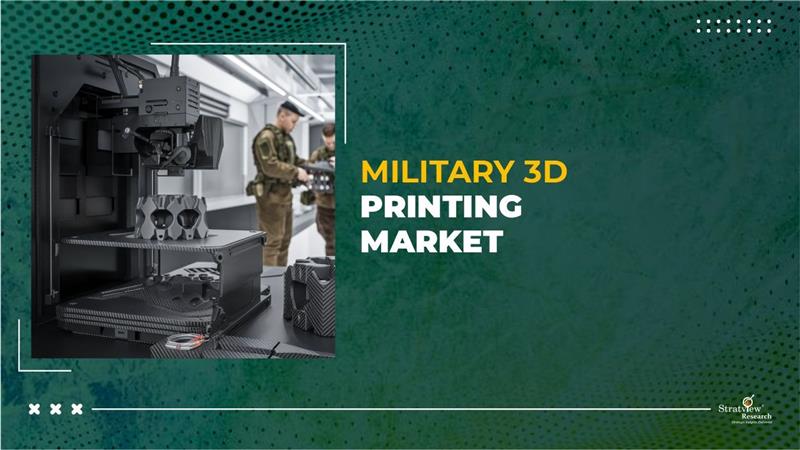
3D printing is transforming military operations by enabling rapid, cost-effective, and on-demand production of critical components. From battlefield repairs and submarine hulls to rapid construction and prototyping, armed forces worldwide are leveraging additive manufacturing to reduce costs, shorten lead times, and strengthen supply chain resilience. With strong adoption led by the US military, the market is set for significant growth through 2027.
In 2020, the US Army needed extra hatch plugs to be mounted on their combat vehicles. Unfortunately, the original manufacturer had discontinued the part and manufacturing them would take 3 months and cost US$ 10,000. However, they managed to get the parts in just a few days for around US$ 800, with a simpler design having 4 parts instead of 10. How did the magic happen? They ‘printed’ the hatch plugs instead of manufacturing them using traditional means.
In recent times, 3D printing has emerged as a revolution across various industries. 3D printing has not only revolutionized industries from aerospace to healthcare but today, is also serving as a soldier on the battlefield. In the initial years of adoption, the use of 3D printing in the military was limited to prototyping whereas now, it is being leveraged for replacement parts of aircraft and submarines, prototyping of potential applications, printing fitment parts, tools and complex customised parts, etc. given the benefits offered by it. Military 3D printing accounts for around 5% of the global 3D printing market and is expected to have a $ 1.1 bn market in 2024.
This article explores how 3D printing is revolutionizing military operations, its applications and challenges, and the promising future it offers.
Us Army: The Flagbearer of 3D Printing
The US Army made the headlines in January 2024 when its Jointless Hull 3D printer, the world’s largest additive and subtractive manufacturing apparatus, won the prestigious 2024 Technical Achievement Award for 3D Printing Innovation at the Military Additive Manufacturing Summit & Technology Showcase. With a print volume of 20 ft x 30 ft x 12 ft, the machine is capable of 3D printing metal components as big as an entire vehicle. This, the development of the world’s largest 3D printing apparatus, is an example of the US Army’s commitment towards the adoption and R&D of 3D printing.

Fig 1. Jointless Hull Project
The US military accounts for >50% of the total military 3D printing across the globe, nearly 120% of the combined spending of the next 5 largest spenders - China, UK, Russia, France and Germany.

Fig 2. Military 3D Printing Market Share: Global Overview
3D Printing: Role in the Battlefield
Why did the US Navy choose to 3D print the submarine hulls instead of manufacturing them using the conventional method? Conventionally, it takes nearly 5 months to build a small submarine and costs around US$ 600,000. However, 3D printing dragged the time of manufacturing to just 4 weeks (80% decrease) and the cost to nearly US$ 60,000 (90% decrease). However, 3D printing has much more to offer than just time and cost- savings. The military operates in extreme weather conditions, cruel and rugged terrain, and limited infrastructure. While combating the enemy under such gruelling conditions, a lack of supply of the needful is the last thing one would desire. 3D printing enables rapid, on-demand, cost-effective, and lightweight production of parts, in turn enabling various applications in the military.
The relentless aspiration of technical superiority drives the military to develop and test new prototypes continuously. Prototyping using 3D printing is rapid because the designs can be directly printed without needing the tooling and assembly steps, much faster compared to the conventional methods, which could take weeks, months, or even years depending on the scale of the project. 3D printing has saved as much as 8 months in prototyping time for some large-scale projects across various industries. Hence, 3D printing has emerged as the go-to prototyping solution for militaries across the world as it saves time and allows the R&D team to come up with multiple iterations in a limited time.
The unpredictability of operations, rapid deployments in remote areas, spare parts required for complex machinery and the sheer scale of operations make it essential for the militaries to have robust supply chains and vast inventories. However, factors like geopolitical instabilities (like wars and political conflicts), natural disasters, and economic fluctuations disrupt the supply chains, leading to reduced operational capability, delayed response, increased casualties, and strategic failures. For example, due to the major supply chain breakdown during the recent war, Ukraine extensively used 3D printing to produce spare/replacement parts (like specific hinges for M113 armoured fighting vehicles), perfectly portraying its capability to combat the supply chain crisis. By enabling the on-demand production of supplies, 3D printing significantly reduces vast inventories and frees up storage and transportation resources, ensuring availability in remote and hostile places and security against global supply chain disruptions.
When operating in remote and hostile environments, breakdowns are common but strongly undesirable considering the logistical challenges posed. In such cases, 3D printing is the go-to solution to manufacture critical components like vehicle replacement parts, armour, weapon parts, and custom tools required for repair. A great example of such an application is the US Navy installing metal 3D printers on its warships like USS Essex and USS Bataan to allow sailors to build replacement parts onboard instead of relying on external supplies taking weeks or months.
Furthermore, militaries across the world are now leveraging 3D printing for rapid construction to fabricate structures like bridges and barracks, as traditional construction methods are time-consuming and resource-intensive. For example, the Indian Army 3D printed a dwelling unit (71 sq. meters in area, two-story, zone-3 earthquake-resilient) in Ahmedabad in just 4 weeks and bunkers (capable of withstanding a hit from a T90 tank) in Ladakh.

Fig 3. Key Benefits of 3D Printing in Military Manufacturing
Barricades in the Combat Zone :
Despite the immense potential and widespread adoption of 3D printing in the military space, it has yet to become the mainstream process replacing conventional manufacturing methods.
3D printing is generally cost-effective in comparison to the traditional methods. However, the upfront cost of the printers remains high and some parts (ex: high-tensile strength parts like Gun Barrels) manufactured using 3D printing are not cost-effective. Moreover, operating and maintaining 3D printers requires specific technical expertise, resulting in additional expenses for extensive personnel training.
Other challenges, such as making significant changes in the existing supply chain to integrate 3D printing, arranging reliable power sources, stable operating environments, secure data transmission in remote or combat environments, and ensuring the security of the digital files (like designs and blueprints) against cyberattacks, make the adoption process cumbersome.
Towards a 3D Printed Medal of Glory:
While the challenges mentioned exist, the industry is marching fast to overcome the hurdles through development and innovation. Developments by private as well as government organisations such as the US Army Combat Capabilities Development Command in material science, autonomous printing through AI, and large-scale printing are making 3d printing increasingly reliable, fast, and cost-effective by each passing day.

Fig 4. Military 3D Printing Market Growth
As the technology matures, its penetration into militaries across the world is poised to deepen. Growing at a CAGR of 14.8%, the global military 3D printing market is expected to reach $ 1.7 billion by 2027 and become an indispensable tool in the hands of militaries worldwide.
Subscribe to our newsletter
Related Articles:
Printed Skies: 3D Printing in the Aerospace Industry
Didn’t find what you were looking for?
Tell us about your requirements
(Our team usually responds within a few hours)