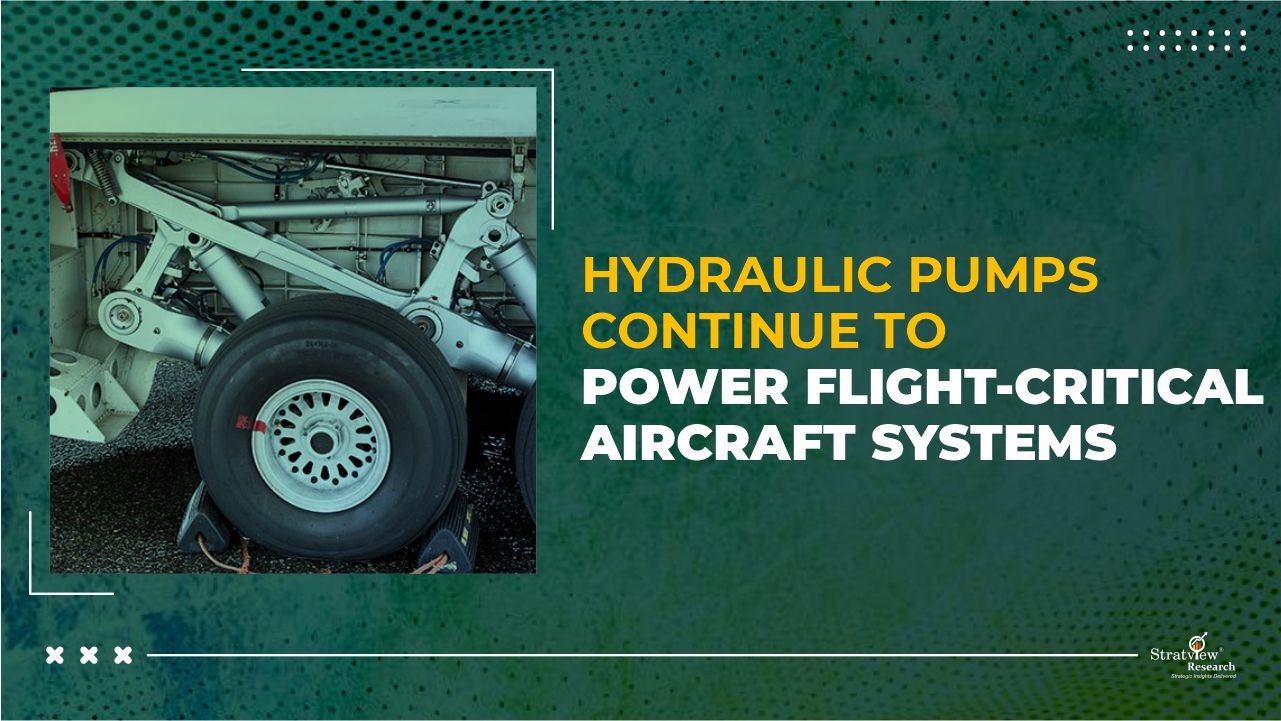
The concept of using hydraulics in aircraft goes back to the early 20th century when pilots sought ways to reduce manual effort in controlling larger aircraft. Before hydraulics, aircraft relied on cable and pulley systems that were heavy and required considerable force from pilots. As aircraft became larger and faster, hydraulic systems were developed to provide greater control authority with reduced pilot workload.
Power architectures of aircraft are evolving gradually as electrification is introduced, efficiency margins are tightened, and digital control becomes standard across flight-critical systems. While certain mechanical interfaces are being streamlined at the aircraft level, the fundamental requirement to generate and sustain high-force, fail-tolerant actuation remains unchanged. In this context, hydraulic pumps continue to provide the highest practical power density, converting mechanical or electrical input into the pressure required to drive flight-critical loads.
Across a modern aircraft, dozens of pump types are installed including – fuel pumps, lube and scavenge pumps, air-conditioning and pressurization pumps, water and waste pumps, etc. While other pumps move fluids from one place to another, usually at steady pressure, Hydraulic pumps, on the other hand, are responsible for moving the aircraft itself. Among all, hydraulic pumps make up the largest share – well over half of the total pumps installed on an aircraft and supporting a market worth around USD 3.5 billion in 2025.
Hydraulic systems often operate in the shadows of engines and avionics, yet they deliver the brute force that moves an aircraft’s most critical components. In an industry pushing for lighter, greener aircraft, hydraulic pumps remain indispensable across platforms.
The Aircraft Functions That Depend on Hydraulic Power
From landing gear and flight control surfaces to brakes and thrust reversers, hydraulic pumps turn mechanical energy into controlled, high-pressure fluid power – a capability no other actuation technology has matched in force density and fail-safe reliability. Hydraulic pumps are meant to be load-intensive that must respond instantly and work reliably every single time.
Flight control systems alone account for two-fifths of total hydraulic pump usage, simply because ailerons, elevators, rudders, flaps, and spoilers, etc., all remain continuously active throughout every phase of flight. Unlike landing gear or thrust reversers, which operate intermittently, flight controls must deliver precise, high-force actuation in real time to counter aerodynamic loads, turbulence, and maneuvering demands, making hydraulics the most practical and dependable solution. Electric actuators have made inroads, but hydraulics still outperform them in terms of force margin and fault tolerance.
Large modern aviation systems are designed with not just one, but multiple independent hydraulic circuits – each with its own pumps (engine-driven, electric, or backup like a Ram Air Turbine (RAT)), precisely because incidents involving partial hydraulic loss do occur, and must be managed without compromising safety.
There have been several documented cases where flights were diverted or returned to airports after hydraulic pumps’ issues were detected, with crews relying on system redundancy and emergency procedures to land safely.
In May 2025, a Delta Boeing 767-300 experienced a significant hydraulic pump failure near New York, forcing the crew to declare an emergency for a high-speed landing with reduced flaps. Another mid-air hydraulic failure (in October 2025) on a commercial flight (Airbus A320neo) underscored how quickly a single pump or pressure loss can cascade into operational disruption, forcing diversions and altered landing configurations.
So, wherever failure is not an option and force cannot be compromised, hydraulic pumps remain embedded.
How Hydraulic Pump Demand Varies by Aircraft Type
Nearly three-quarters of global aircraft hydraulic pump installations sit on commercial aircraft, and the reason is simple – commercial aviation simply operates at a scale no other segment matches – higher production volumes, higher utilization rates, and far more flight cycles per aircraft.
The global commercial fleet comprises >35,550 aircraft as of June 2025 says the International Air Transport Association (IATA), with Boeing and Airbus collectively account for 80% of the current active fleet.
Furthermore, this fleet is predominantly composed of narrowbody jets, reflecting their versatility and lower unit operating costs on most short- and medium-haul routes. As per IATA, the narrowbodies represent ~60% of the total fleet, with two aircraft families-the A320 (including neo variants) and the 737 (including Max)-accounting for over 90% of this segment.
This narrowbody-heavy fleet composition has direct implications for aircraft system architectures, particularly hydraulics. In practice, commercial aircraft hydraulic systems operate across two primary pressure classes: 3000–4000 psi and 5000 psi.
To optimize weight, reliability, and maintenance economics across high-cycle operations, most narrowbody platforms are designed around 3000–4000 psi hydraulic systems, a pressure range that has become the industry norm. 5000 psi systems are limited to select widebodies, namely the Airbus A350, A380, and Boeing 787, and a small number of military aircraft and helicopters.
Hydraulic Pumps: A Mature Technology with Enduring Strategic Relevance
The concept of using hydraulics in aircraft goes back to the early 20th century when pilots sought ways to reduce manual effort in controlling larger aircraft. Before hydraulics, aircraft relied on cable and pulley systems that were heavy and required considerable force from pilots. As aircraft became larger and faster, hydraulic systems were developed to provide greater control authority with reduced pilot workload.
A century later, hydraulic pumps remain just as mission-critical as they were at inception – and their relevance is not diminishing. Despite advances in electrification, hydraulics continue to offer unmatched power density, responsiveness, and reliability for primary flight controls, landing gear, and braking systems.
Across global aerospace markets, demand for hydraulic pumps is generated across both OEM and aftermarket channels, with OEM programs accounting for the larger share. Given the North America’s concentration of aircraft manufacturers and current backlog driven delivery outlook, the region continues to command a high share of this demand. Major OEMs such as Boeing and Lockheed Martin, coupled with high defense spending, large installed commercial and military fleets, and continuous R&D investment, keep hydraulic pump requirements structurally strong.
A second, equally important driver is fleet age. As of early 2026, commercial aircraft retirements remain near historic lows, largely due to persistent supply chain constraints and production shortfalls at major OEMs such as Boeing and Airbus. Aircraft are staying in service longer, sustaining aftermarket demand for hydraulic pumps through maintenance, repair, and replacement cycles.
Together, these structural factors support a global market valued at ~USD 3.5 billion in 2025, projected to reach around USD 4.7 billion by 2034. The growth profile reflects long-term program continuity and fleet realities rather than short-term production swings.
Authored by Stratview Research. Also published on – Power Motion Tech
Subscribe to our newsletter
Related Articles:
The High-Revving Market of Aircraft Engine Seals
Didn’t find what you were looking for?
Tell us about your requirements
(Our team usually responds within a few hours)